One Greek Who Excelled in Arts and Literature and What Did He Do
The ancient Romans and Greeks had a highly liberated attitude toward sex—one that is surprising, even by today's standards. They had gods devoted to it, festivals to partake in it, and local economies that surrounded it. Sexual practice was not something to exist aback of or subconscious from public view. Rather, information technology was something to rejoice in.
tenPhallic Bricks Of Pompeii
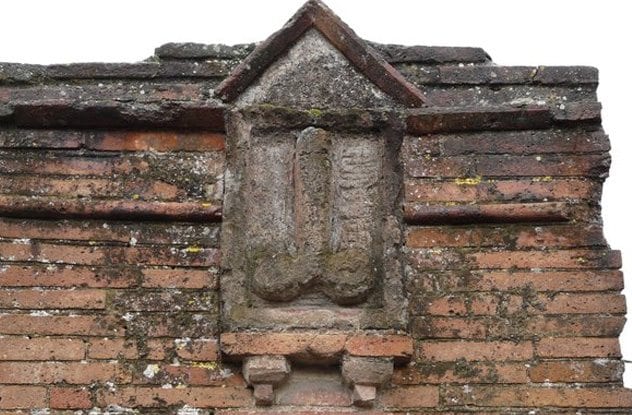
We all know the legend surrounding Pompeii. The original City of Sin's people basked in a perpetual heat of promiscuity—promiscuity said to have inspired the gods' rage with the eruption of Mount Vesuvius in Advertizing 79. Since earthworks of its near-perfectly preserved remains began in the 18th century, archaeologists have discovered a great deal regarding Pompeii'due south sexual identity.
Pompeii's economy thrived on more than than twoscore brothels, the most famous of which was named "Lupanare Grande," translated today as "pleasance firm." The rooms in these brothels were often cramped and dim, with a small straw mattress positioned beneath a piece of pornographic artwork hung on the wall. Despite their appearances, information technology would be misleading to allocate these brothels every bit the seedy underbelly of Pompeii'southward economy. Rather, they existed on a highly public and unashamed platform, alongside the forum and communal bath houses, both of which were important sites of a larger (public) sex organisation.
Visit the ruins of Pompeii today, and you lot will no doubt meet the "phallic bricks" of Pompeii pointing the way to the nearest pleasure house with an erect phallus engraved into its stone. And if those weren't clear enough markers, erect phalluses were frequently positioned above the doors of brothels and private residences as tidings of skilful luck.
9Voyeurism
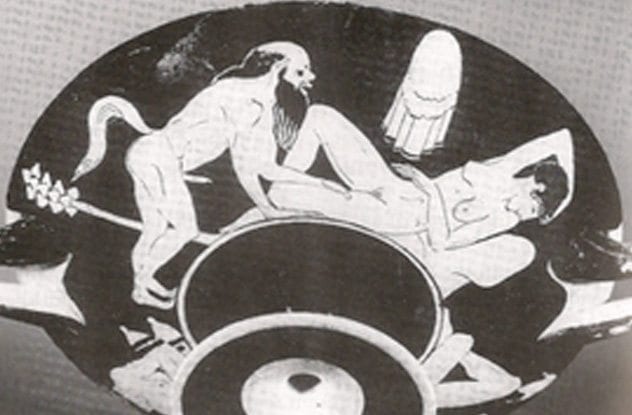
"Yous may expect, simply don't touch," was somewhat of a guiding theme across Ancient Roman and Greek artwork, as indicated by the many pieces of art uncovered today displaying such provocations. One could discover this for themselves at The Gabinetto Segreto in the National Archaeological Museum of Naples.
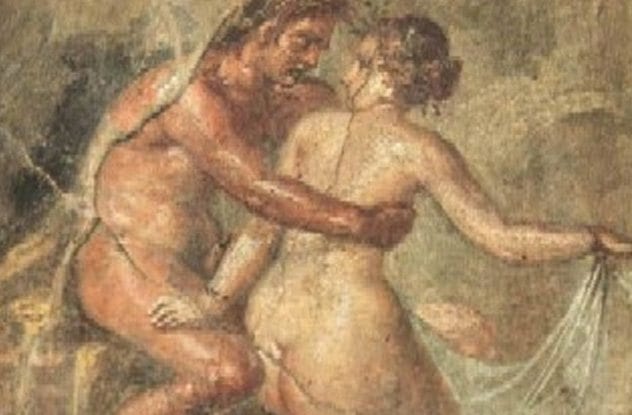
This "Secret Cabinet" houses a collection of erotic artwork from Ancient Rome. One such wall painting from, unsurprisingly, Pompeii, displays this voyeurism with a man and a woman having intercourse in front of their attendant, who is visible in the background.
In Ancient Greece, at that place exists a body of art dedicated to Maenads, the feverous female person followers of Dionysus, the Greek god of wine, ritual madness, religious euphoria, and theatre. Artwork surrounding these women were highly explicit, and the sexual acts represented by the artwork displayed the figures equally objects to be observed. This idea of voyeurism in erotic fine art was twofold, where a voyeur existed within the artwork, every bit was the case in one hydria painting Sleeping Maenad and Satyrs, equally well as external to the artwork, where the onlooker (or "innocent bystander") too became a voyeur.
8The Wife-Sharing Economy
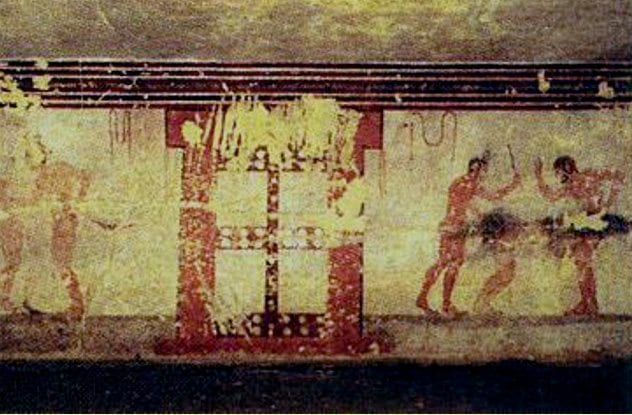
The Etruscan civilisation was assimilated into the Roman Republic during the 4th century BC. However, their community remained largely intact.
The Etruscan women were known for their liberated mental attitude toward intercourse and nudity. They kept their bodies in fit condition and often walked around in the nude, enjoying the pleasure of all men who came by. "Marriage" was a loose construct. It was common for children to accept no clue who their father was, and for women not to inquire.
Frescoes painted on the Tombs of The Bulls, The Bigas, and The Floggings, in Tarquinia, brandish these kinds of erotic scenes.
viiFruitful Competition Of The Sexes
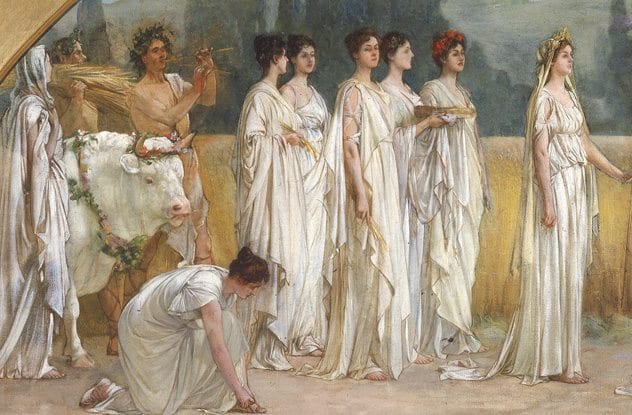
Kenneth Reckford, an expert of the Classics, analyzed Aristophanes's work in a series of essays entitled Aristophanes'due south Old-and-New Comedy. I essay, "Aischrologia," addresses the flavour ritual of Thesmophoria in Aboriginal Greece. Just married Athenian women participated in this ritual, which aimed to promote fertility. In preparation, women would abstain from intercourse and oftentimes bathe as an human activity of purification. During this three-twenty-four hour period thing, women would perform various acts of "fertility magic." In addition, they would share lewd jokes and tales of their indecencies, and play with toys replicating both the male and female genitals.
This ritual, coupled with the Eleusinian Haloa festival, gave women the opportunity to release pent-up sexual frustration through liberal utilize of sexual practice symbols, pornographic sweets, raucous activities, and free-range slut-shaming—for lack of a better phrase. During Haloa, according to Reckford, Greek women could "say the most ugly and shameful things to one another," shooting insults at each other regarding sexuality and vulgarity, while proclaiming their own indiscretions.
6Fun At The Funfair
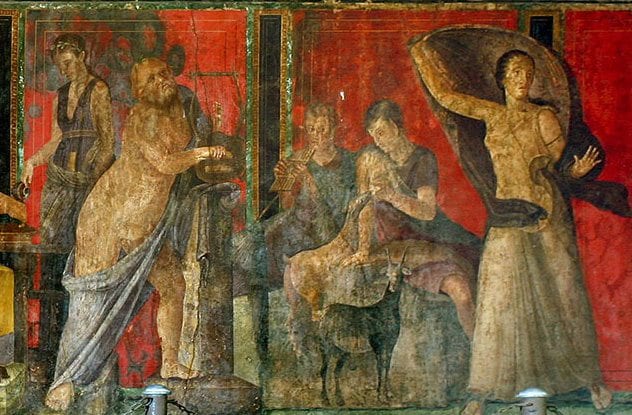
Co-ordinate to Mikhail Bakhtin, a scholar of literary theory and philosophy, the Carnival of ancient literature was a free-for-all, where people would throw class division, respect, and sensitivity out the window. There was no "proverb no," and certainly no saying "also much." Carnival was pure id. Suspend reality and imagine a scene of extravagance, with banquets of nutrient and wine, laughter, and sex. At Carnival, everyone was equal, and even degrading remarks inspired a regenerative energy—though, that may exist in part due to the number of drugs and intoxicants they used to strip inhibitions.
Arthur Edward Waite in his book A New Encyclopedia of Freemasonry says, "The Festivals were orgies of wine and sex: there was every kind of drunkenness and every aberration of sex activity, the one leading upwardly to the other. Over all reigned the Phallus."
These Carnival rituals date dorsum to equally early as the 5th century BC and were held during the jump equinox. It should come equally no surprise that these festivals, called The Dionysian Mysteries, were dedicated to Dionysus, the Greek god of all your earthly desires and the enabler of all your poor conclusion-making. This carnival inspired the Roman equivalent, Bacchanal.
Most of the initiation procedure for men and women are known thanks to a collection of frescoes preserved in the Villa of the Mysteries in Pompeii. And, in all fairness, it is a flake reminiscent of what ane might expect in Greek life initiation today. The murals a declaration of initiation at the anxiety of the priestess followed by a descent into the underworld (katabasis), before returning anew. Aristophanes, in his play The Frogs, assumes the origin of this ritual with descent of Dionysis into Hades.
5Before Viagra, At that place Was Priapus
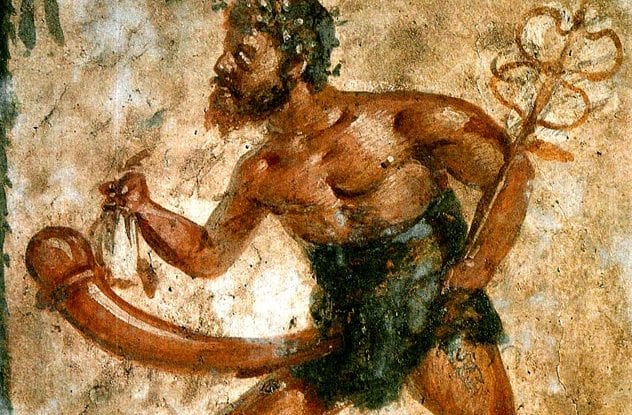
The Greeks had a very house relationship with the phallus—more an obsession, actually. In particular was Priapus, the Greek god equivalent to Dionysus, known for his extremely long and permanently cock penis. If you remember you recognize the term, information technology's considering Priapus inspired the medical term priapism.
And fifty-fifty if Priapus didn't play too well with the other gods, he was revered on Earth. The Priapeia contains a drove of 95 poems dedicated to the sexually driven vulgarity of Priapus.
With this gift of dingy pictures
from the tract of Elephantis
Lalage asks if the horny
deity could assistance her do it
just similar in the illustrations
The law which (equally they say) Priapus coined
for boys appear immediately subjoined
"Come pluck my garden's contents without blame
if in your garden I tin do the same."
ivThey Threw Some Serious Shade
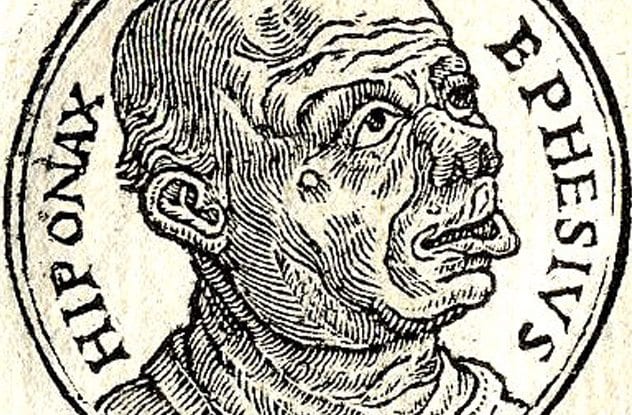
Hipponax of Ephesus was a highly controversial iambic poet, even for ancient Greece. Where he excelled were his insults, which were raunchy and lewd and often satirical of the high (dignified) linguistic communication of his targets.
In fact, as the story goes, he was so good at insults, they drove one victim to suicide. Hipponax was plain subsequently the girl of Bupalus, simply Hipponax's plain-featured looks ultimately led to his rejection. In jest, Bupalus fabricated a statue of Hipponax and then ugly that Hipponax retaliated with accusations of Bupalus having an incestuous human relationship with his mother:
"Bupalus, the mother-
Other notable shade interpreted in Hipponax'south work includes the autopsy of Bupalus'south name, Bou-phallus, meaning quite literally "ox phallus," and the ever-charming "interprandial pooper," pregnant a person who must become up during the middle of a repast to defecate.
threeUsing Sex For World Peace
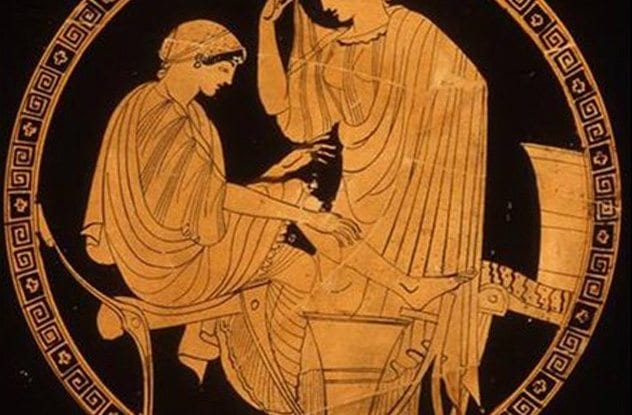
Aristophanes, considered i of the most famous comic playwrights of ancient Greece, was known for his poignant commentary of the social and political landscapes of Athens during the belatedly fifth and early fourth centuries BC. In one such play, Lysistrata, Aristophanes parodies warfare with a battle of the sexes.
The women use the men'due south desires against them, forcing forbearance to compel peace between the Athenians and the Spartans. Women thus use their sexuality to put things in perspective for men, and to ultimately remind them of the "transcendental significance" of sex. According to the women, the men had forgotten this among their stubbornness over more trivial matters, like war.
In the end, Peace appears to the men every bit a immature, naked woman to remind the men of their sexual desires to "plow a few furrows" and "work a few loads of fertilizer in." The men, in turn, realize the importance of sex to their society plenty that they put state of war behind them.
two"Ars Amatoria"
A brusk cry from Karma Sutra was the piece of work of one Ancient Roman poet, Ovid (43 BC–AD 17). His work provided teaching for sexual proclivities, with titles including "Amores" (Love), "Medicamina Faciei" (Remedies for Love) "Remedia Amoris," and virtually infamously, "Ars Amatoria" (the Art of Love). While his piece of work may sound wholesome, Ars Amatoria became a guidebook for lovers and adulterers alike.
In many means, he created The Game, which confuses both men and women to this twenty-four hours. He advises men to let their women miss them—only non too much, while advising women to make their men jealous at times, to ensure they exercise not grow lax nor lazy. In the chamber, Ovid details what form women should accept, to not merely maximize pleasance for themselves, simply also to make it well-nigh pleasurable to the man's gaze. In ane sense, he moved away from the notion of women as possession—equally they were equal players in the game of love—while on the other hand, reinforcing manipulative tactics to proceed i's lover constantly on their toes.
Though his language never broke into vulgarity, it was quite explicit in its detail, and in a matter of poor timing, resulted in his exile by Augustus, who was still coping with the news of his daughter's copulations.
1Martial
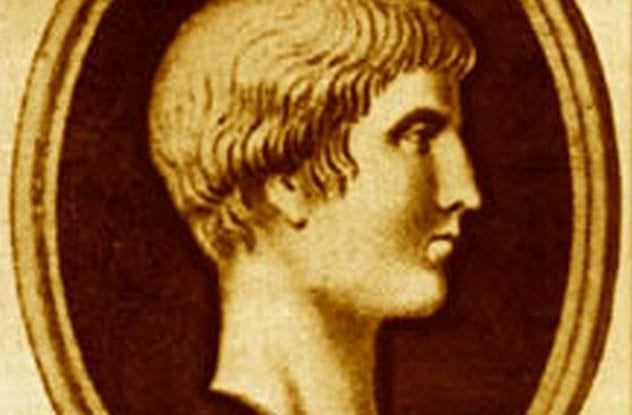
Every bit with other emotional impulses, daze lies in the space between expectations and reality. Marcus Valerius Martialis, or Martial, was a Roman poet from commencement century, who was fabricated famous by his 12 books of epigrams. To this day, Martial's epigrams are shocking due to their obscene, and oftentimes graphic, language. If nothing else, their vulgarity sheds light on the type of work published at the time.
Epigrams 79 and fourscore of Book III convey vulgarity in a singled-out structure. In these epigrams, insults are initially targeted at the subjects' character and are then redirected by insulting subjects' sexual "short-cummings." In Epigram 79, Martial begins by declaring:
"Sertorius finishes aught, and starts everything. When he fornicates, I don't suppose he completes."
Martial's sharp words pivot this insult more pointedly at Sertorius'due south sexual incapability. Besides, Epigram fourscore introduces its subject with a more full general observation followed by a hyper-sexualized ascertainment.
"You talk of nobody, Apicius, speak sick of nobody, still rumor says you accept an evil tongue."
While the former could pose as a general remark to Apicius'southward soft-spoken graphic symbol, the latter angles the reader to the true central insult: Apicius'due south skill at oral sex activity. Here, "evil" is more than probable a term for "wild," suggesting that Apicius'south tongue causes his sexual partner to lose command and that he is skillful at giving caput. The explicit quality of this language indicates the level of tolerance Ancient lodge had at the time regarding sex.
Emma Marie is a student, lensman, traveler, and certified freediver.
aquinochaketherver.blogspot.com
Source: https://listverse.com/2017/03/23/10-kinky-tendencies-of-the-ancient-romans-and-greeks/
0 Response to "One Greek Who Excelled in Arts and Literature and What Did He Do"
Post a Comment