School of the Art Institute of Chicago Modern Wing Floor Plan
 | |
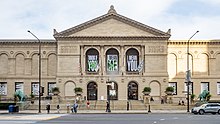 As seen from Michigan Ave | |
| Location inside Chicago metropolitan surface area Evidence map of Chicago metropolitan area Art Constitute of Chicago (Illinois) Testify map of Illinois Art Institute of Chicago (the United States) Show map of the United States | |
| Established | 1879; in nowadays location since 1893 |
|---|---|
| Location | 111 South Michigan Avenue Chicago, Illinois 60603 U.s.a. |
| Coordinates | 41°52′46″Northward 87°37′26″West / 41.87944°N 87.62389°W / 41.87944; -87.62389 Coordinates: 41°52′46″Northward 87°37′26″Due west / 41.87944°Due north 87.62389°Westward / 41.87944; -87.62389 |
| Collection size | 300,000 works |
| Visitors | 1.79 million (2016)[one] 365,660 (2020) (drib due to COVID-19 pandemic closures)[2] |
| Director | James Rondeau |
| Public transit access | CTA Jitney routes: (6 and 28 line) 'Fifty' and Subway stations: Adams-Wabash: Brown Line Green Line Orange Line Pink Line Purple Line Monroe/State: Ruddy Line Monroe/Dearborn: Blueish Line Metra Railroad train: Van Buren Street Station |
| Website | www.artic.edu |


The Art Institute of Chicago in Chicago's Grant Park, founded in 1879, is one of the oldest and largest art museums in the world. Recognized for its curatorial efforts and popularity amid visitors, the museum hosts approximately i.5 million people annually.[3] Its drove, stewarded by 11 curatorial departments, is encyclopedic, and includes iconic works such as Georges Seurat's A Sunday on La Grande Jatte, Pablo Picasso's The Old Guitarist, Edward Hopper'south Nighthawks, and Grant Forest's American Gothic. Its permanent collection of well-nigh 300,000 works of art is augmented by more than 30 special exhibitions mounted yearly that illuminate aspects of the drove and present cutting-edge curatorial and scientific research.
As a research institution, the Art Institute also has a conservation and conservation science department, five conservation laboratories, and one of the largest art history and compages libraries in the state—the Ryerson and Burnham Libraries.
The growth of the collection has warranted several additions to the museum's 1893 building, which was constructed for the World's Columbian Exposition. The most contempo expansion, the Modernistic Wing designed past Renzo Pianoforte, opened in 2009 and increased the museum's footprint to nearly one meg square anxiety, making it the second-largest art museum in the Usa, later the Metropolitan Museum of Art.[four] The Art Constitute is associated with the School of the Art Institute of Chicago, a leading art school, making information technology ane of the few remaining unified arts institutions in the United states.
In 2017, the Art Institute received 1,619,316 visitors, and was the 35th near-visited art museum in the world.[5] Notwithstanding, in 2020, due to the COVID-19 pandemic, the museum was closed for 169 days, and attendance plunged by 78 percent from 2019, to 365,660.[6]
History [edit]
In 1866, a group of 35 artists founded the Chicago Academy of Design in a studio on Dearborn Street, with the intent to run a gratis school with its own fine art gallery. The organization was modeled afterward European fine art academies, such equally the Royal Academy, with Academicians and Acquaintance Academicians. The University's charter was granted in March 1867.
Classes started in 1868, meeting every day at a cost of $10 per month. The Academy's success enabled information technology to build a new habitation for the school, a five-story stone building on 66 West Adams Street, which opened on November 22, 1870.
When the Great Chicago Fire destroyed the building in 1871 the University was thrown into debt. Attempts to continue despite the loss past using rented facilities failed. Past 1878, the Academy was $x,000 in debt. Members tried to rescue the ailing institution by making deals with local businessmen, earlier some finally abased it in 1879 to found a new organization, named the Chicago Academy of Fine Arts. When the Chicago Academy of Design went bankrupt the same twelvemonth, the new Chicago Academy of Fine Arts bought its assets at sale.

This 1893 sketch of the so new Fine art Institute of Chicago shows most of today'south Grant Park still submerged under Lake Michigan, with the railroad tracks running along the shoreline behind the Museum
In 1882, the Chicago University of Fine Arts changed its name to the current Fine art Constitute of Chicago and elected as its first president the broker and philanthropist Charles L. Hutchinson, who "is arguably the single most of import individual to have shaped the direction and fortunes of the Fine art Constitute of Chicago".[7] : 5 Hutchinson was a managing director of many prominent Chicago organizations, including the Academy of Chicago,[viii] and would transform the Art Institute into a world-course museum during his presidency, which he held until his death in 1924.[9] Besides in 1882, the system purchased a lot on the southwest corner of Michigan Avenue and Van Buren Street for $45,000. The existing commercial building on that property was used for the organization's headquarters, and a new addition was constructed backside information technology to provide gallery space and to house the school's facilities.[7] : nineteen By Jan 1885 the trustees recognized the need to provide additional space for the organization'south growing collection, and to this end purchased the vacant lot direct southward on Michigan Avenue. The commercial building was demolished,[ten] and the noted architect John Wellborn Root was hired by Hutchinson to design a building that would create an "impressive presence" on Michigan Avenue,[7] : 22–23 and these facilities opened to great fanfare in 1887.[vii] : 24
With the announcement of the World's Columbian Exposition to be held in 1892–93, the Art Institute pressed for a building on the lakefront to exist synthetic for the fair, but to be used by the Institute afterwards. The metropolis agreed, and the building was completed in time for the 2d twelvemonth of the off-white. Construction costs were met by selling the Michigan/Van Buren property. On October 31, 1893, the Institute moved into the new building. For the opening reception on December 8, 1893, Theodore Thomas and the Chicago Symphony Orchestra performed.
From the early on 1900s (to the 1960s the school offered with the Logan Family (members of the lath) the Logan Medal of the Arts, an award which became one of the most distinguished awards presented to artists in the U.s.a.. Between 1959 and 1970, the institute was a central site in the boxing to proceeds art and documentary photography a place in galleries, under curator Hugh Edwards and his assistants.
As Director of the museum starting in the early 1980s, James N. Wood conducted a major expansion of its collection and oversaw a major renovation and expansion projection for its facilities. As "one of the most respected museum leaders in the land", as described by The New York Times, Wood created major exhibitions of works by Paul Gauguin, Claude Monet and Vincent van Gogh that set records for attendance at the museum. He retired from the museum in 2004.[xi]
The Establish began construction of "The Modern Wing", an improver situated on the southwest corner of Columbus and Monroe in the early 21st century.[12] The project, designed by Pritzker Prize–winning architect Renzo Piano, was completed and officially opened to the public on May sixteen, 2009. The 264,000-foursquare-foot (24,500 yardtwo) edifice addition fabricated the Fine art Institute the 2d-largest art museum in the United States. The edifice houses the museum's world-renowned collections of 20th and 21st century fine art, specifically modern European painting and sculpture, contemporary art, architecture and design, and photography. In its inaugural survey in 2014, travel review website and forum, Tripadvisor, reviewed millions of travelers' surveys and named the Fine art Establish the world's best museum.[13]
The museum received perhaps the largest souvenir of art in its history in 2015.[14] Collectors Stefan Edlis and Gael Neeson donated a "collection [that] is among the world's greatest groups of postwar Pop fine art ever assembled".[15] The donation includes works past Andy Warhol, Jasper Johns, Cy Twombly, Jeff Koons, Charles Ray, Richard Prince, Cindy Sherman, Roy Lichtenstein and Gerhard Richter. The museum agreed to go on the donated work on display for at to the lowest degree fifty years.[15] In June 2018, the museum received a $50 million donation, the largest single announced budgetary donation in its history.[xvi]
Collection [edit]
The drove of the Art Institute of Chicago encompasses more than than 5,000 years of homo expression from cultures around the world and contains more than 300,000 works of art in 11 curatorial departments, ranging from early Japanese prints to the art of the Byzantine Empire to gimmicky American fine art. It is principally known for one of the United States' finest drove of paintings produced in Western civilization.[17] [xviii]
African Art and Indian Art of the Americas [edit]
The Art Plant'southward African Art and Indian Art of the Americas collections are on display across ii galleries in the south end of the Michigan Avenue edifice. The African collection includes more than 400 works that span the continent, highlighting ceramics, garments, masks, and jewelry.[19]
The Amerindian collection includes Native North American art and Mesoamerican and Andean works. From pottery to textiles, the collection brings together a wide array of objects that seek to illustrate the thematic and artful focuses of art spanning the Americas.[20]
American Art [edit]
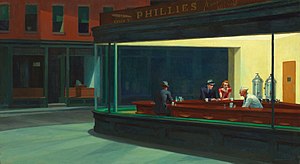

The Art Plant's American Art drove contains some of the all-time-known works in the American canon, including Edward Hopper's Nighthawks, Grant Forest's American Gothic, and Mary Cassatt's The Kid's Bath. The collection ranges from colonial silver to modern and contemporary paintings.
The museum purchased Nighthawks in 1942 for $3,000;[21] [22] [23] its acquisition "launched" the painting into "immense popular recognition".[24] Considered an "icon of American culture",[21] [25] Nighthawks is perhaps Hopper's most famous painting, besides as ane of the most recognizable images in American art.[26] [27] [28] Also well known, American Gothic has been in the museum'southward drove since 1930 and was merely loaned outside of North America for the kickoff time in 2016.[29] Forest'south painting depicts what has been chosen "the most famous couple in the world", a dour, rural-American, father and daughter. Information technology was entered into a competition at the Art Constitute in 1930, and although not a favorite of some, it won a medal and was acquired by the museum.[30] [31]
Ancient and Byzantine [edit]
The Fine art Institute's ancient drove spans nearly iv,000 years of art and history, showcasing Greek, Etruscan, Roman, and Egyptian sculpture, mosaics, pottery, jewelry, drinking glass, and bronze too as a robust and well-maintained collection of aboriginal coins. In that location are around 5,000 works in the collection, offer a comprehensive survey of the ancient and medieval Mediterranean world, showtime with the third millennium B.C. and extending to the Byzantine Empire.[32] The collection likewise holds the mummy and mummy case of Paankhenamun.[33] [34]
Architecture and Design [edit]
The Department of Compages and Design holds more than 140,000 works, from models to drawings from the 1870s to the present day. The collection covers mural architecture, structural applied science, and industrial blueprint, including the works of Frank Lloyd Wright, Ludwig Mies van der Rohe, and Le Corbusier.[35]
Asian Art [edit]
The Art Constitute's Asian collection spans most 5,000 years, including significant works and objects from China, Korea, Japan, India, Southeast Asia, and the Near and Middle East. There are 35,000 objects in the drove, showcasing bronzes, ceramics, and jades likewise every bit textiles, screens, woodcuts, and sculptures.[36] One gallery in item attempts to mimic the quiet and meditative fashion in which Japanese screens are traditionally viewed.
European Decorative Arts [edit]

The Art Plant's collection of European decorative arts includes some 25,000 objects of furniture, ceramics, metalwork, glass, enamel, and ivory from 1100 A.D. to the present day. The department contains the ane,544 objects in the Arthur Rubloff Paperweight Collection and the 68 Thorne Miniature Rooms–a collection of miniaturized interiors of a one:12 scale showcasing American, European, and Asian architectural and furniture styles from the Middle Ages to the 1930s (when the rooms were synthetic).[37] Both the paperweights and the Thorne Rooms are located on the ground floor of the museum.
European Painting and Sculpture [edit]

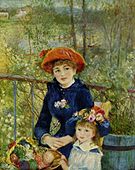
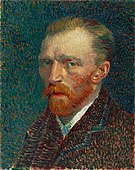
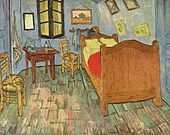
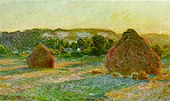
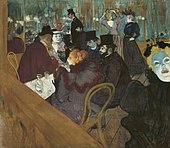
The museum is most famous for its collections of Impressionist and Post-Impressionist paintings, widely regarded every bit 1 of the finest collections exterior of France.[38] Highlights include more than 30 paintings past Claude Monet, including 6 of his Haystacks and a number of Water Lilies. Also in the collection are important works by Pierre-Auguste Renoir such equally Two Sisters (On the Terrace), and Gustave Caillebotte's Paris Street; Rainy Day. Post-Impressionist works include Paul Cézanne'south The Handbasket of Apples, and Madame Cézanne in a Xanthous Chair. At the Moulin Rouge by Henri de Toulouse-Lautrec is another highlight. The pointillist masterpiece, which also inspired a musical and was famously featured in Ferris Bueller'due south 24-hour interval Off, Georges Seurat's Dominicus Afternoon on La Grande Jatte—1884, is prominently displayed. Additionally, Henri Matisse's Bathers by a River, is an important example of his work. Highlights of not-French paintings of the Impressionist and Mail service-Impressionist collection include Vincent van Gogh's Sleeping accommodation in Arles and Self-portrait, 1887.
In the mid-1930s, the Art Constitute received a gift of over one hundred works of art from Annie Swan Coburn ("Mr. and Mrs. Lewis Larned Coburn Memorial Collection"). The "Coburn Renoirs" became the core of the Fine art Found'south Impressionist painting collection.[39]
The collection also includes the Medieval and Renaissance Fine art, Arms, and Armor holdings, including the George F. Harding Collection of arms and armor,[twoscore] and three centuries of Sometime Masters works.[41]
Modernistic and Contemporary Art [edit]
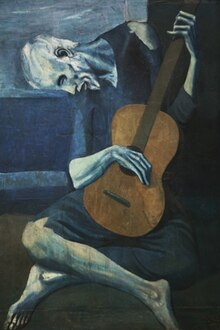
The museum'due south collection of modern and contemporary art was significantly augmented when collectors Stefan Edlis and Gael Neeson gifted 40 plus master works to the department in 2015.[42] Pablo Picasso's Old Guitarist, Henri Matisse's Bathers past a River, Constantin Brâncuși'south Gilded Bird, and René Magritte's Fourth dimension Transfixed are highlights of the modern galleries, located on the third flooring of the Mod Wing.[43] The gimmicky installation, located on the second floor, contains works past Andy Warhol, Cindy Sherman, Cy Twombly, Jackson Pollock, Jasper Johns, and other significant modern and contemporary artists.
Photography [edit]
The Art Found didn't officially plant a photography collection until 1949, when Georgia O'Keeffe donated a meaning portion of the Alfred Stieglitz collection to the museum.[44] Since then, the museum's collection has grown to approximately 20,000 works spanning the history of the artform from its inception in 1839 to the present.
Prints and Drawings [edit]
The impress and drawings collection began with a donation by Elizabeth S. Stickney of 460 works in 1887, and was organized into its own department of the museum in 1911.[45] Their holdings have subsequently grown to 11,500 drawings and 60,000 prints, ranging from 15th-century works to gimmicky. The collection contains a strong group of the works of Albrecht Dürer, Rembrandt van Rijn, Francisco Goya, and James McNeill Whistler. Considering works on paper are sensitive to low-cal and degrade apace, the works are on display infrequently in order to keep them in good condition for as long as possible.
Textiles [edit]
The Section of Textiles has more than 13,000 textiles and 66,000 sample swatches in total, covering an array of cultures from 300 B.C. to the present. From English needlework to Japanese garments to American quilts, the drove presents a diverse group of objects, including contemporary works and cobweb art.[46]
Architecture [edit]

Michigan Avenue entrance today
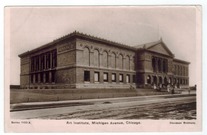
A postcard of the Art Plant dated 1907
The current edifice at 111 South Michigan Avenue is the third address for the Fine art Institute. It was designed in the Beaux-Arts style by Shepley, Rutan and Coolidge of Boston[47] for the 1893 Globe's Columbian Exposition as the Earth'due south Congress Auxiliary Edifice with the intent that the Art Constitute occupy the infinite afterwards the fair closed.
The Fine art Constitute's famous western entrance on Michigan Avenue is guarded past two bronze lion statues created by Edward Kemeys. The lions were unveiled on May 10, 1894, each weighing more than than two tons. The sculptor gave them unofficial names: the south lion is "stands in an attitude of defiance", and the northward lion is "on the cruise". When a Chicago sports team plays in the championships of their respective league (i.e. the Super Bowl or Stanley Loving cup Finals, not the entire playoffs), the lions are frequently dressed in that squad's uniform. Evergreen wreaths are placed effectually their necks during the Christmas flavour.
The due east archway of the museum is marked by the stone curvation entrance to the sometime Chicago Stock Exchange. Designed by Louis Sullivan in 1894, the Exchange was torn down in 1972, but salvaged portions of the original trading room were brought to the Art Institute and reconstructed.
The Art Found building has the unusual belongings of straddling open up-air railroad tracks. Two stories of gallery space connect the east and due west buildings while the Metra Electric and Southward Shore lines operate below. The lower level of gallery space was formerly the windowless Gunsaulus hall, merely is now home to the Alsdorf Galleries showcasing Indian, Southeast Asian and Himalayan Art. During renovation, windows facing north toward Millennium Park were added. The gallery infinite was designed past Renzo Piano in conjunction with his design of the Modern Fly and features the same window screening used there to protect the art from direct sunlight. The upper level formerly held the modern European galleries, merely was renovated in 2008 and at present features the Impressionist and Post-Impressionist galleries.
Libraries [edit]

Located on the footing floor of the museum is the Ryerson & Burnham Libraries. The Libraries' collections cover all periods of art, but is nearly known for its extensive drove of 18th to 20th century architecture. It serves the museum staff, college and academy students, and is also open up to the general public. The Friends of the Libraries, a support group for the Libraries, offers events and special tours for its members.
Modern Wing [edit]
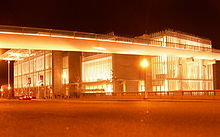
Fine art Institute of Chicago Modern Wing
On May 16, 2009, the Art Establish opened the Mod Wing, the largest expansion in the museum'southward history.[48] The 264,000-square-pes (24,500 ktwo) addition, designed past Renzo Piano, makes the Art Institute the second-largest museum in the The states.[4] The architect of record in the City of Chicago for this building was Interactive Design.[49] The Modern Fly is home to the museum's collection of early 20th-century European art, including Pablo Picasso's The Old Guitarist, Henri Matisse's Bathers past a River, and René Magritte's Time Transfixed. The Lindy and Edwin Bergman Drove of Surrealist art includes the largest public brandish of Joseph Cornell's works (37 boxes and collages).[50] The Fly also houses gimmicky fine art from after 1960; new photography, video media, architecture and design galleries including original renderings by Frank Lloyd Wright, Ludwig Mies van der Rohe and Bruce Goff; temporary exhibition space; shops and classrooms; a buffet and a restaurant, Terzo Piano, that overlooks Millennium Park from its terrace.[51] In improver, the Nichols Bridgeway connects a sculpture garden on the roof of the new wing with the adjacent Millennium Park to the n and a courtyard designed past Gustafson Guthrie Nichol. In 2009, the Modern Fly won at the Chicago Innovation Awards.[52]
Selections from the permanent collection [edit]
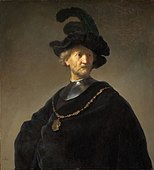
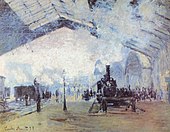
Notation that other notable works are in the collection but the post-obit examples are ones in the public domain and for which pictures are available. In 2018, every bit it redesigned its website, the Fine art Plant released 52,438 of its public domain works, under the Artistic Eatables Zero (CC0) licence.[53]
Paintings [edit]
-

-
-

-

-

-
-

-
-

Paul Cézanne, The Bay of Marseilles, view from L'Estaque, 1885
-

-

-
-
-
-

-
-
-

Pablo Picasso, 1904, Woman with a Helmet of Hair, gouache on tan wood lurid board
-

-

-

Kazimir Malevich, Painterly Realism of a Football game Histrion—Color Masses in the 4th Dimension, 1915
-

-

Sculptures [edit]

More than highlights from the collection [edit]
-

1 of the Thorne Miniature Rooms, c. 1930s
-

Pieces from the porcelain collection in the Fine art Found of Chicago
-

Museum hall
Governance [edit]
Attendance [edit]
During 2009, attendance was effectually 2 one thousand thousand—upwardly 33 per centum from 2008—in addition to a total of approximately 100,000 museum memberships. Despite a 25 percent heave in museum admission fees, the Modern Wing was a major catalyst for a rise in visitor traffic.[54]
Finances [edit]
Equally of 2011, the Art Establish continues to rebuild its $783 meg endowment since the recession.[55] In June 2008, its endowment was $827 million. As of 2012, the museum is rated A1 past Moody's, its fifth-highest grade, in part reflecting the museum's alimony and retirement liabilities; Standard & Poor's rates the museum A+, fifth-all-time. In October 2012, the Art Institute sold near $100 million of taxable and tax-exempt bonds partly to shore upwards unfunded alimony obligations.[56]
The $294 million extension in 2009 was the culmination of a $385 one thousand thousand fundraising campaign—roughly $300 one thousand thousand for design and structure and $85 meg for the endowment. Around $370 million were raised primarily from private patrons in Chicago.[57] In 2011, the Art Institute received a $10 one thousand thousand souvenir from the Jaharis Family unit Foundation to renovate and expand galleries devoted to Greek, Roman and Byzantine fine art, likewise as to back up acquisitions and special exhibitions of that art.[58]
Acquisitions and deaccessioning [edit]
In 1990, the Art Institute of Chicago sold 11 works at auction, including paintings by Claude Monet, Pablo Picasso, Amedeo Modigliani, Maurice Utrillo and Edgar Degas, to heighten the $12 million purchase toll of a bronze sculpture, Gilt Bird, by Constantin Brâncuși. At the time, the sculpture was owned by the Arts Club of Chicago, which was selling it to purchase a new gallery for its other works.[59] In 2005, the museum sold two paintings by Marc Chagall and Auguste Renoir at Sotheby's.[sixty] In 2011, it auctioned ii Picassos (Sur l'impériale traversant la Seine (1901) and Verre et pipe (1919)), Henri Matisse's Femme au fauteuil (1919), and Georges Braque's Nature morte à la guitare (rideaux rouge) (1938) at Christie'south in London.[61] [62]
Directors [edit]
- William M.R. French (1885–1914)
- Newton Carpenter (1914–1916)
- George Eggers (1918–1921)
- Robert Harshe (1921–1938)
- Daniel Catton Rich (1938–1958)
- Allen McNab (1956–1965)
- Charles Cunningham (1965–1972)
- East. Laurence Chalmers (1972–1986)
- James N. Forest (1980–2004)
- James Cuno (2004–2011)
- Douglas Druick (2011–2016)
- James Rondeau (2016–present)
Controversy [edit]
Management of investments dispute [edit]
In 2002, the Fine art Institute of Chicago filed accommodate alleging fraud past a small Dallas firm called Integral Investment Direction, forth with related parties. The museum, which put $43 one thousand thousand of its endowment into funds run by the defendants, claimed that it faced losses of up to 90% on the investments afterward they soured.[63]
Structure disputes [edit]
In 2010, the yr later the opening of its massive Mod Wing, the Art Institute of Chicago sued the engineering firm Ove Arup for $10 million over what it said were flaws in the physical floors and air-circulation systems. The suit was settled out of courtroom.[64] [65]
Docent program diversity dispute [edit]
In 2021, the Art Institute ended its unpaid volunteer docents programme to move to a paid model. The Chicago Tribune editorial page criticized the Intitute'due south alphabetic character announcing the change and the move to a new model, arguing that "[o]nce y'all cutting through the blather, the letter basically said the museum had looked critically at its corps of docents, a grouping dominated by generally (only not entirely) white, retired women with some fourth dimension to spare, and constitute them wanting as a demographic."[66] The Institute'south director, Robert Grand. Levy, responded in a Tribune op-ed supporting the modify, and described the Tribune'southward editorial as having "numerous inaccuracies and mischaracterizations", noted that the docent program had already been largely on break for the past xv months due to the COVID pandemic, and argued that the determination was not about anyone's identity, information technology was in keeping with changing modern museum practices effectually the globe.[67]
Post-obit a volunteerism surge in the late 1940s, the plan had been created in 1961 to revitalize and expand "programming for children."[68] Among other matters, since 2014 the program had been trying to attract a more than diverse socioeconomic perspective fix of fine art-tour guides, given the unpaid fourth dimension commitment needed.[69]
In popular civilisation [edit]
Director John Hughes included a sequence in the Fine art Establish in his 1986 film Ferris Bueller's Day Off, which is gear up in Chicago. During it the characters are shown viewing A Sunday Afternoon on the Island of La Grande Jatte. Hughes had kickoff visited the Constitute every bit a "refuge" while in high school. Hughes' commentary on the sequence was used as a reference betoken by journalist Hadley Freeman in a discussion of the Republican presidential chief candidates in 2011.[71]
The paintings used in the 1970 Parker Brothers lath game Masterpiece are works held in the Art Institute's collection.[72] [ non-main source needed ]
Come across besides [edit]
- American Academy of Fine art
- Bessie Bennett, early on 20th century Curator of Decorative Art
- Forest Idyll
- List of well-nigh-visited museums in the United states
- List of museums and cultural institutions in Chicago
- Alme Meyvis
- Visual arts of Chicago
References [edit]
- ^ Johnson, Steve (January 25, 2017). "Chicago museums set attendance records in 2016". Chicago Tribune . Retrieved 2021-01-29 .
- ^ Art Paper List of Most-Visited Art museums, 31 March 2021
- ^ "Visitor Figures 2013: Museum and exhibition attendance numbers compiled and analysed" (PDF). The Art Paper (International ed.). XXIII (256). April 2014.
- ^ a b Smith, Roberta (May xiii, 2009). "A Grand and Intimate Modern Art Trove". The New York Times . Retrieved 2011-06-13 .
- ^ "Exhibition and Museum Visitor Figures 2017". The Art Paper. March 26, 2018. Retrieved 2021-10-11 .
- ^ Sharpe, Emily; da Silva, José (March 30, 2021). "Company Figures 2020: top 100 fine art museums revealed as attendance drops by 77% worldwide". The Art Paper.
- ^ a b c d Hilliard, Celia (2010). "The Prime Mover" - Charles L. Hutchinson and the making of the Art Institute of Chicago. Chicago: The Art Institute of Chicago. ISBN978-086559-238-iv.
- ^ "Few Changes Fabricated - University of Chicago Trustees Hold an Election - Two Vacancies Filled - Other Members Whose Terms Expired Re-Elected - Examinations for Positions as Teachers in the Public Schools of the Metropolis". The Daily Inter-Bounding main: 1. June 28, 1893.
- ^ Dillon, Diane (September eighteen, 2004). Art Institute of Chicago. Encyclopedia of Chicago. The Newberry Library. Retrieved 2015-07-24 .
- ^ "The Art Institute – The Western Fine art Movement and its Excellent Achievements in Chicago – The New Domicile of the Fine Arts – The Ward Drove – The Century, Harper's - The Formal Opening of the New Museum – The Loan Collection – A Noble Triumph". The (Chicago) Inter Ocean. XVI (239): 9. Nov 20, 1887.
- ^ Kennedy, Randy (June xiv, 2010). "James Northward. Forest, President of the Getty Trust, Dies at 69". The New York Times. Retrieved 2010-06-21.
- ^ Kamin, Blair (May 31, 2005). "Art Institute to Add New Fly". Chicago Tribune . Retrieved 2021-01-29 .
- ^ Grossman, Samantha (September xviii, 2014). "These Are the 25 Best Museums in the World". Time . Retrieved 2014-09-xix .
- ^ Johnson, Steve (April 22, 2015). "Art Institute of Chicago gets its largest gift e'er, including ix Warhols". Chicago Tribune.
- ^ a b Chappell, Nib (April 22, 2015). "Gift Worth $400 Million To Art Establish Of Chicago Includes Works By Warhol". WBEZ News.
- ^ Johnson, Steve (April 17, 2018). "Art Institute lands largest appear greenbacks donation, $70 million in total". Chicago Tribune . Retrieved 2021-01-29 .
- ^ Chilvers, Ian, ed. (2004). The Oxford Dictionary of Fine art: The Art Found of Chicago . Oxford University Press. pp. 813–814. ISBN978-0-1928-0022-0.
Celebrated masterpieces: Nighthawks; American Gothic; A Dominicus Afternoon on the Island of La Grande Jatte.
- ^ "World's nigh cute museums". Fox News. May 3, 2013. Retrieved 2013-05-04 .
Must-see masterpieces: Georges Seurat's A Sunday on the Island of La Grande Jatte, Nighthawks, and Vincent Van Gogh's Bedroom in Arles.
- ^ "Arts of Africa". Art Institute of Chicago . Retrieved 2019-08-ten .
- ^ "Arts of the Americas". Art Institute of Chicago . Retrieved 2016-08-03 .
- ^ a b "Nighthawks". Art Found of Chicago.
- ^ The sale was recorded by Josephine Hopper as follows, in volume Two, p. 95 of her and Edward'due south periodical of his art: "May 13, '42: Chicago Art Institute - 3,000 + render of Compartment C in exchange as role payment. 1,000 - one/3 = 2,000." See Deborah Lyons, Edward Hopper: A Journal of His Work New York: Whitney Museum of American Art, 1997, p. 63.
- ^ "Art Establish of Chicago". visual-arts-cork.com.
- ^ Levin, Gail (1996). "Edward Hopper's Nighthawks, Surrealism, and the War". Art Found of Chicago Museum Studies. 22 (two): 180–195 at 189, 193–194. doi:10.2307/4104321. JSTOR 4104321.
- ^ "Edward Hopper". A Closer Look. National Gallery of Fine art. 2006. Archived from the original on 2013-03-12. Retrieved 2013-04-30 .
- ^ "About This Artwork: Nighthawks, 1942". Art Plant of Chicago . Retrieved 2013-05-04 .
- ^ Simon, Scott (2002-ten-07). "Present at the Creation: Edward Hopper's Nighthawks". Morning Edition. NPR. Archived from the original on 2013-06-01. Retrieved 10 September 2018.
- ^ Wood, James N. (1996). The Art Institute of Chicago, 20th-Century: Painting and Sculpture. Hudson Hills. ISBN978-0-8655-9096-0.
- ^ "American Gothic". Fine art Institute of Chicago . Retrieved 2016-08-03 .
- ^ Fineman, Mia (June viii, 2005). "The Most Famous Farm Couple in the World: Why American Gothic still fascinates". Slate.
- ^ "About This Artwork: American Gothic". Fine art Plant of Chicago. Archived from the original on 28 May 2010. Retrieved June 20, 2010.
- ^ "Ancient and Byzantine". Art Institute of Chicago . Retrieved 2016-08-03 .
- ^ "Coffin and Mummy Case of Paankhenamun" (PDF). The Art Institute of Chicago . Retrieved 2013-01-13 .
- ^ "Bury and Mummy of Paankhenamun". Fine art Institute of Chicago . Retrieved 2016-08-03 .
- ^ "Architecture and Blueprint". Fine art Institute of Chicago . Retrieved 2016-08-03 .
- ^ "Asian Fine art". Fine art Found of Chicago . Retrieved 2016-08-03 .
- ^ "Thorne Miniature Rooms". Fine art Institute of Chicago. Archived from the original on June 15, 2011. Retrieved 2011-06-thirteen .
- ^ Galloway, Paul, and Alan G. Artner (September 29, 1996). "City's Impressionist Trove Rooted in House of Palmer". Chicago Tribune. Retrieved 2019-x-28.
- ^ "Case 8: Annie Swan Coburn". Women of the Art Institute . Retrieved 2018-06-16 .
- ^ Karcheski, Jr., Walter J. (1995). "Essay: George F. Harding, Jr. and His "Castle"". Fine art Institute of Chicago . Retrieved January 29, 2021.
- ^ "Arms, Armor, Medieval, and Renaissance". Art Institute of Chicago. Archived from the original on 2016-07-31. Retrieved 2016-08-03 .
- ^ Johnson, Steve (December 9, 2015). "Massive art gift transforms Art Institute". Chicago Tribune . Retrieved 2016-08-03 .
- ^ "Modern Art". Fine art Institute of Chicago . Retrieved 2016-08-03 .
- ^ "Photography". Art Institute of Chicago . Retrieved 2016-08-03 .
- ^ Engelbrecht, Theresa Moir. "Inter-Collected: The Shared History of the Print Order and Museum Collection," Art in Print. Vol. 7 No. 2 (July–August 2017), 30.
- ^ "Textiles". Art Institute of Chicago . Retrieved 2016-08-03 .
- ^ "1879–1913: The Formative Years". Art Institute of Chicago. 2007. Archived from the original on June 9, 2007. Retrieved 2007-06-20 .
- ^ Ourossof, Nicolai (May 13, 2009). "Renzo Pianoforte Embraces Chicago". The New York Times. Archived from the original on 2011-05-13. Retrieved 2011-06-13 .
- ^ "The Modern Wing At The Art Institute Of Chicago". Interactive Design Architects . Retrieved 2020-08-06 .
- ^ Seaman, Donna (March 23, 1997). "Joseph Cornell's Works At The Art Establish". Chicago Tribune.
- ^ "A New Kind of Institutional Dining". Zagat. May 27, 2009. Archived from the original on May 5, 2019.
- ^ "2009 Chicago Innovation Award winners". Chicago Innovation Awards. Archived from the original on 2010-03-11.
- ^ Neault, Michael (22 October 2018). "Behind the Scenes of the Website Redesign". Art Institute of Chicago . Retrieved 2018-11-29 .
- ^ Viera, Lauren (May 9, 2011). Art Establish leader resigns Chicago Tribune.
- ^ Crow, Kelly. (August 24, 2011), "Chicago's Art Institute Names New Director". The Wall Street Journal.
- ^ Chappatta, Brian. (October ix, 2012). "Chicago Art Institute Borrows $100 Million for Pensions". Bloomberg Businessweek.
- ^ Kaufman, Jason Edward. (May xiii, 2009). "Fine art Plant of Chicago'due south massive extension opens". Archived October 16, 2012, at the Wayback Auto The Fine art Newspaper.
- ^ Taylor, Kate (Feb 27, 2011). "A Gift for Art Institute". The New York Times.
- ^ Chicago Gallery to Sell 11 Works to Buy Brancusi Los Angeles Times. United Press International, May x, 1990.
- ^ Vogel, Carol (October 26, 2005). "Museums Set up to Sell Art, and Some Experts Cringe". The New York Times.
- ^ Viera, Lauren (Jan eleven, 2011). "Art Institute paintings to fetch $10-$16 million at auction". Chicago Tribune.
- ^ Pogrebin, Robin (January 26, 2011). "The Permanent Drove May Not Be So Permanent". The New York Times.
- ^ "Stick to paintings". The Economist. 3 January 2002. Retrieved 2014-ten-24 .
- ^ Finkel, Jori (iii June 2014). "Eli Wide'due south Art Showcase, Nevertheless Unfinished, Sues Over Delays in Los Angeles". The New York Times.
- ^ Kapos, Shia (17 September 2013). "Art Constitute closes Modern Fly's third floor for vii months". Crain's Chicago Concern . Retrieved 2014-10-24 .
- ^ "Shame on the Art Constitute for Summarily Canning Its Docents". Chicago Tribune. September 21, 2021.
- ^ Levy, Robert M. (September 30, 2021). "Op-ed: The Fine art Establish — and its critics — must comprehend change". Chicago Tribune . Retrieved 2021-10-eleven .
- ^ "Expanding the Museum'south Bear upon". Learn with Us. The Art Plant Chicago. Archived from the original on 21 March 2020. Retrieved 12 October 2021.
Volunteerism surged in the United States in the postwar catamenia […] In this context, the Art Institute's Adult female's Board was established in 1952 […] The Woman'south Board also helped to create the museum'southward Docent Program in 1961 with the Junior League of Chicago as a ways of revitalizing and expanding programming for children
- ^ "Art Institute of Chicago Ends Its Volunteer Docent Program". WBEZ News. one October 2021.
- ^ Freeman, Hadley (Nov fifteen, 2011). "Two new films reveal the death and triumph of the American dream". The Guardian. London.
- ^ "Masterpiece". BoardGameGeek . Retrieved ten September 2019.
External links [edit]
- Official website

- Fine art Found's Impressionistic collection, YouTube
aquinochaketherver.blogspot.com
Source: https://en.wikipedia.org/wiki/Art_Institute_of_Chicago
0 Response to "School of the Art Institute of Chicago Modern Wing Floor Plan"
Post a Comment