Alameda City History of Discriminating Agains Minorities
Introduction*
Segregation is one of our nation's most enduring and intractable problems. More than 60 years since the Supreme Court'southward landmark Brown v. Board of Education decision denounced racial segregation in primary and secondary public schools, and l years since the enactment of the federal Fair Housing Act, our neighborhoods and schools have all the same to reflect the rich diversity of our nation as a whole. In far too many cases, racial segregation is as severe or worse today than a generation ago. Racially segregated neighborhoods and schools are visible in every part of the United states of america.
Segregation seems embedded in our nation's material while, simultaneously, the United States has become a more than diverse country. Paradoxically, demographic changes since the 1960s complicate our understanding of segregation. The San Francisco Bay Area is a case in signal.1 The Bay Area is roughly 39 percent white, 6 percent Blackness, 26 percent Asian, 24 per centum Latino and five percent "other," including Native American, Pacific Islander, and multi-racial.two While the region is overall diverse, there are few neighborhoods or cities in the region that reverberate that variety. Racial variety within the region, however, makes measuring and understanding the patterns of racial segregation more challenging.three The nigh popular and widely used measures of segregation only measure segregation between two racial groups at a fourth dimension.iv
Given the seriousness of the problem of racial segregation every bit a cause of racial inequality and the complexities in understanding the nature of this problem, the Haas Institute is launching a series of briefs that will attempt to illuminate these patterns and demystify the reality of segregation in the San Francisco Bay Expanse. Many organizations take published maps that point the distribution of specific racial groups across space.5 Sometimes, these racial limerick maps are used to suggest the level or changes in racial residential segregation.6 In some of our own reports, we take produced maps that illustrate the percentage of people of color or people of detail racial groupings throughout the Bay Expanse to imply as much.7 But racial composition and racial segregation are non the aforementioned thing. This is the showtime report, to our knowledge, that will map and illustrate residential racial segregation itself for multiple racial groups simultaneously within the Bay Area. We attempt to fill a gap in the reporting on race in the Bay Surface area by refocusing on this important simply hard outcome.
In this offset brief, we present a series of detailed maps illustrating segregation across the region, inside each of the nine Bay Area counties, and in its major metropolitan areas. Our goal is that readers in the Bay Area, for the offset fourth dimension, will accept a clear portrait of the reality and extent of the racial segregation in their communities. We volition highlight and discuss the varying levels of residential racial segregation within the region and show which communities and neighborhoods are the most segregated, and the well-nigh integrated.8 Unfortunately, integrated communities are the exception that proves the rule, as nosotros will prove. Merely a handful of cities in region are both diverse and highly integrated.
In our second brief nosotros volition disaggregate and untangle patterns of segregation into specific patterns of racial demographics. We will examine the unique patterns of racial distribution in the San Francisco Bay region, and across major metropolitan areas. In particular, part two of this series volition illustrate the distribution of white, Black, Latino, and Asian populations across each large metropolitan area and many counties. We will likewise examine specific areas of racial clustering and concentration, non simply segregation, and examine how these demographic changes accept occurred over time. Thus, nosotros will better sympathise how patterns of residential modify, migration and displacement contribute to segregation today and as a matter of historical fact.
Our third cursory will focus on the complicated outcome of how best to measure segregation, with a review that describes diverse measures of racial segregation used past demographers, geographers, and social scientists, including the contrast alphabetize, the isolation and exposure indices, as well every bit more than novel measures that are both quantitative and qualitative. We volition weigh their advantages and disadvantages, and explicate why we settled on the Departure Index as the best measure for the Bay Area. In the process, we will compare results from different indices to form a more bright and rounder portrait of segregation in the Bay Expanse. Part three will then examine longitudinal patterns of segregation using some of those measures over time within the Bay Area, using different segregation metrics to better describe how these patterns have changed over fourth dimension. Each measure is a partial glimpse into a multi-faceted reality. But by juxtaposing the best measures can we all-time understand the underlying reality of racial segregation.
The fourth brief will explain the significance of the problem of segregation, and delve more than securely into the harms of segregation. Without being exhaustive, nosotros volition briefly survey an immense social science literature. Nosotros will illustrate how racial segregation is a primary mechanism that isolates too many people of colour, especially children, from life-enhancing resources, and is a disquisitional determinant of racial inequality in areas such every bit educational operation and attainment, wellness outcomes, and upward economic mobility.nine Segregation, as we will testify, is non but a separation of particular groups of people from each other, but from opportunity and resources. As such, segregation is the root cause of racial inequality in the Us.
The fifth and last brief in this series volition propose and advance a number of policy principles that take the potential to alleviate the problem of segregation and reduce measurable segregation. This brief will examine the Bay Area's projected level of racial residential segregation going forrad, and suggest targets for changing that trajectory. Segregation is the production of historical and contemporary policy and systems/structures, likewise every bit private activity. Without describing specific bills or measures, the focus of this cursory will be to offer specific policy principles that have the potential to improve the enduring problem of segregation.
Our immediate purpose in this cursory is to illustrate vividly patterns of segregation inside the Bay Area utilizing compelling maps and data analysis, thereby drawing greater and more detailed attention to a problem that has remained stubbornly persistent. We besides provide the divergence index calculations by demography tract to facilitate applied research using our data. Our hope is that these maps and our accompanying analysis will convey an undeniable fact of life in the San Francisco Bay Expanse, and by doing so will spur and advance policy and advocacy discussions on how to mitigate or ameliorate them.
Segregation in the Bay Surface area
The San Francisco Bay Area, like most of the Us, is deeply segregated. The Bay Area is visibly segregated at the regional, county, metropolitan, municipal, and neighborhood levels. Each of the nine counties as well as the two major "Metropolitan Statistical Areas" (MSAs) is marked by high levels of racial segregation.10 To illustrate this, we present the following maps of the Bay Area using a multi-racial measure of segregation using data from 2010 decennial census, supplemented, with data from the more recent American Community Survey (ACS) estimates where noted.11
To measure and represent segregation spatially, we utilise the Divergence Index, a decomposable measure of segregation which measures the difference between the overall proportion of a grouping in a region and the proportion of each group in a local area within that region.12 Different many other measures of segregation, the Divergence Index can measure a region's segregation for multiple racial groups simultaneously. A comparison of this mensurate with alternative measures of segregation will exist presented in the third brief in this series.
Immediately below is a map of the unabridged Bay Area. This map illustrates the caste of racial segregation across the region. The region, and each of the county and MSA maps presented in this cursory, are shaded into three categories illustrating the degree of segregation measured for that geography: high, moderate, or low. In each map, census tracts are shaded based upon their departure index score.13 Each map likewise contains a pie chart indicating the racial breakdown of the larger geography presented. In the canton and MSA maps, some tracts are encircled by a boundary color indicating a racial group that predominates, respective to the pie chart.
The San Francisco Bay Expanse is a racially, geographically, and economically various region of more than 7 million people and more 100 incorporated municipalities contained within nine counties. The demographic profiles and levels of racial diversity in each of the counties vary considerably from the region as a whole, especially those further from the cadre of the region or major urban centers. For that reason, the regional map above and the private county maps below illustrate the deviation between census tracts and each county as a whole rather than census tracts and the unabridged region every bit a whole.fourteen This allows united states to observe the degree of divergence from a more advisable context, especially for the whiter and more rural counties.15
As the map in a higher place suggests, we find racial segregation in every county and MSA in the region.16 Despite the racial diversity that exists through most of the Bay Area, segregated neighborhoods exist in every function of the region, from north to south, and east to due west. As we will signal, far too few census tracts in the region resemble the populations in the Bay Area as a whole, let lone of the counties or MSAs in which they reside.
As a byproduct of this inquiry, nosotros plant two general forms of segregation in the region: inter-municipal and intra-municipal. Nigh of the traditionally recognized "segregated neighborhoods," where people of colour were historically restricted on business relationship of redlining and other forms of housing bigotry, are typically found inside the larger, broadly various municipalities such as San Francisco, Oakland, San Jose, and mid-sized cities such equally Berkeley and Richmond. The displacement of many people of colour from these communities and the corresponding in-migration of white families over the last twenty years has diversified the municipal populations in these cities, but has not always resulted in more integrated neighborhoods.17 Thus, although these cities are various in aggregate, they tend to contain some of the most racially segregated non-white neighborhoods in the Bay Area.
Much of the racial segregation observed in the Bay Area, on the other hand, exists between municipal boundaries. That is, the segregation of one group into a particular municipality or maintenance of historically segregated residential patterns has as a corollary the segregation of many members of other racial groups into other racially segregated cities and or neighborhoods in other cities. Inter-municipal or inter-district segregation is why, every bit many educational experts have noted, American schools remain stubbornly segregated.18 This also why, although a bulk of the most highly segregated neighborhoods for people of color are found in the largest cities in the region, the near segregated white neighborhoods are in small or mid-sized cities.
Although only suggested by the to a higher place map, nosotros observe that whites are the most segregated racial group in the region.19 Although whites are simply under 40 percentage of the population of the Bay Area, 184 census tracts (of 1582) are more than 75 percent white, 359 tracts are more than 66 percentage white, and 663 tracts are more than fifty percentage white. Some of this is explained by the fact that the more than rural counties of Marin, Sonoma, and Napa have proportionally much larger white populations than counties such every bit Contra Costa, Alameda and San Francisco. But whites are the virtually segregated group even in counties where they are a racial plurality and/or a minority, and take less exposure to members of other racial groups than any other racial group has to each other.20
It may seem strange to describe whites equally the nigh segregated racial group, just it is a byproduct of the segregation of people of color. The more effective whites are at segregating themselves from people of colour, the more segregated people of colour will be overall. The segregation of non-whites into unduly non-white neighborhoods results in whites residing in disproportionately whiter neighborhoods. Non-white and white segregation are reciprocal; they are flip sides of the same coin. The fact that whites are the nigh segregated racial grouping reflects this, but it as well suggests that people of color are less segregated from each other than they are from whites.
Although Asians are just 26 percent of the population of the Bay Area, they are a bulk of the population is 181 census tracts, more than than 66 percent in fifty census tracts, and compose 75 percent or more in 18 demography tracts.
Latinos are 24 percent of the population in the Bay Surface area, simply are 50 percent or more of the population 143 demography tracts, more than 66 percent of the population in fifty census tracts, and more than 75 percent of the population in xx census tracts.
African Americans are just 6 per centum of the population of the Bay Expanse, but are more than 25 per centum of the population in 93 census tracts, more than 40 percent of the population in xl demography tracts, and more than 50 pct of the population in eighteen census tracts. African Americans are the almost racially concentrated group in the Bay Area, with 75 percentage of the Bay Area'south Blackness residents residing in but 26 percent of the region's census tracts.
Every bit nosotros will show in future briefs, these patterns of racial segregation are not "natural," or simply the result of individual housing preferences, but the byproduct of exclusionary policies besides as private housing bigotry. The extreme segregation of whites into cities such as Piedmont, Lafayette, Atherton, Menlo Park, and Walnut Creek is the result of processes that besides segregate people of color in other places. As a result, for example, African-Americans are segregated into neighborhoods such as Hunter'southward Betoken in San Francisco, and Eastward Oakland and West Oakland, as yous can see in the Alameda County map below.
Segregation by County in the Bay Area
Alameda County
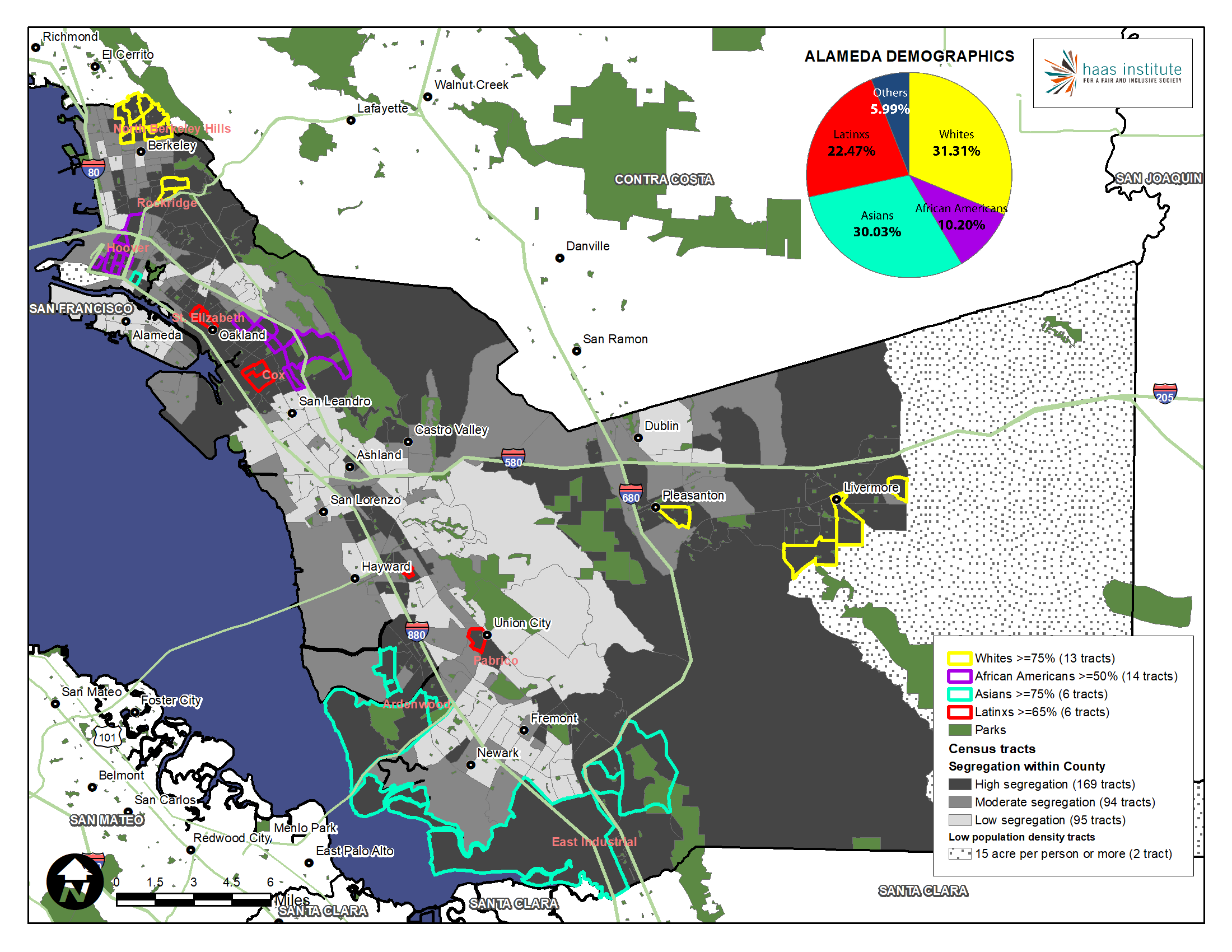
Featuring one of the most vibrant and diverse metropolitan areas in the nation, Alameda County contains the urban center of Oakland and surrounding suburbs and much of what is regarded as "the E Bay." Yet, every bit this map vividly illustrates, its racial diversity is not reflected in almost of the communities within the county. Less than one in 5 census tracts reverberate the demographics of the county for whatever racial group. Just nineteen percent of its tracts have a similar proportion of white people to the county's population. For Latinos, Asian, and Black people, those percentages are 19 percent, fifteen percent, and 18 percent, respectively.
Overall, the diversity of the canton is spread into detail, racially identifiable cities and enclaves within the canton. Only a few places like Newark, which is 26 percent white, 30 percent Asian, 5 per centum blackness, and 34 percent Latino, and San Leandro (26 percent white, 37 percent Asian, 8 percent black, and 22 per centum Latino) approximates the demographics of the county as a whole. Dublin and Emeryville are among the more integrated cities, although they are predominantly and more than heavily white.
Cities such equally Piedmont just north of Oakland, and Pleasanton and Livermore in the eastern reaches of the canton typify the heavily white suburb, with populations that are roughly two-thirds white (xxx per centum greater than the canton as a whole), 1-3 percent Black, and the remainder Latino and/or Asian. Every bit we will see in the next brief in this serial, these patterns of racial segregation are historical in nature, and not of recent origin.
The cities of Albany, Alameda, Castro Valley are (moderately) segregated and predominantly white, although less intensely than the cities simply mentioned, largely on account of heavier Asian minority populations. These cities are roughly 44-48 percentage white, with nineteen-27 percent Asian, and 13-twenty pct Latino, and iv-9 percent black.
Cities similar Fremont and Union City in the southern and southwestern function of the canton illustrate another expression of segregation. Asians constitute 61 percent of the demographics of Fremont, with whites at 19 per centum, and Latinos at thirteen pct, and but 2 per centum African-American. Union City is 56 percent Asian, xv percentage white, five percent blackness, and 18 percent Latino. Both cities are diverse, but too with stiff Asian majorities and therefore segregated. Hayward similarly expresses this blazon of segregation, but with a heavy Latino plurality.
Although nearly of the segregation inside Alameda Canton is inter-municipal -- pregnant that the segregation of whites and non-whites is reciprocal, a number of cities exhibit a strong degree of intra-municipal or neighborhood segregation. Although the city of Oakland is exceptionally diverse (27 percent white, 15 percent Asian, 28 percent Latino, 23 percent Black), it contains some of the nigh segregated neighborhoods in the Bay Area. As the map above illustrates, African Americans in particular are racially segregated in the eastern flatlands of Oakland and west Oakland, while the Oakland hills are unduly white. In fact, 8 of the x virtually segregated demography tracts in the entire Bay Expanse for African Americans are located in Alameda County.21
The urban center of Berkeley too reflects this basic pattern, while not as diverse as Oakland. Berkeley is 52 percent white, and 48 percent people of color, but the white population is segregated into the northern part of the metropolis, and a sizable racially segregated Blackness population wedged into census tracts in the southern function of the city. This pattern, like well-nigh of the segregation establish in the Bay Area, is a continuation of historical patterns set decades ago.22
Contra Costa County
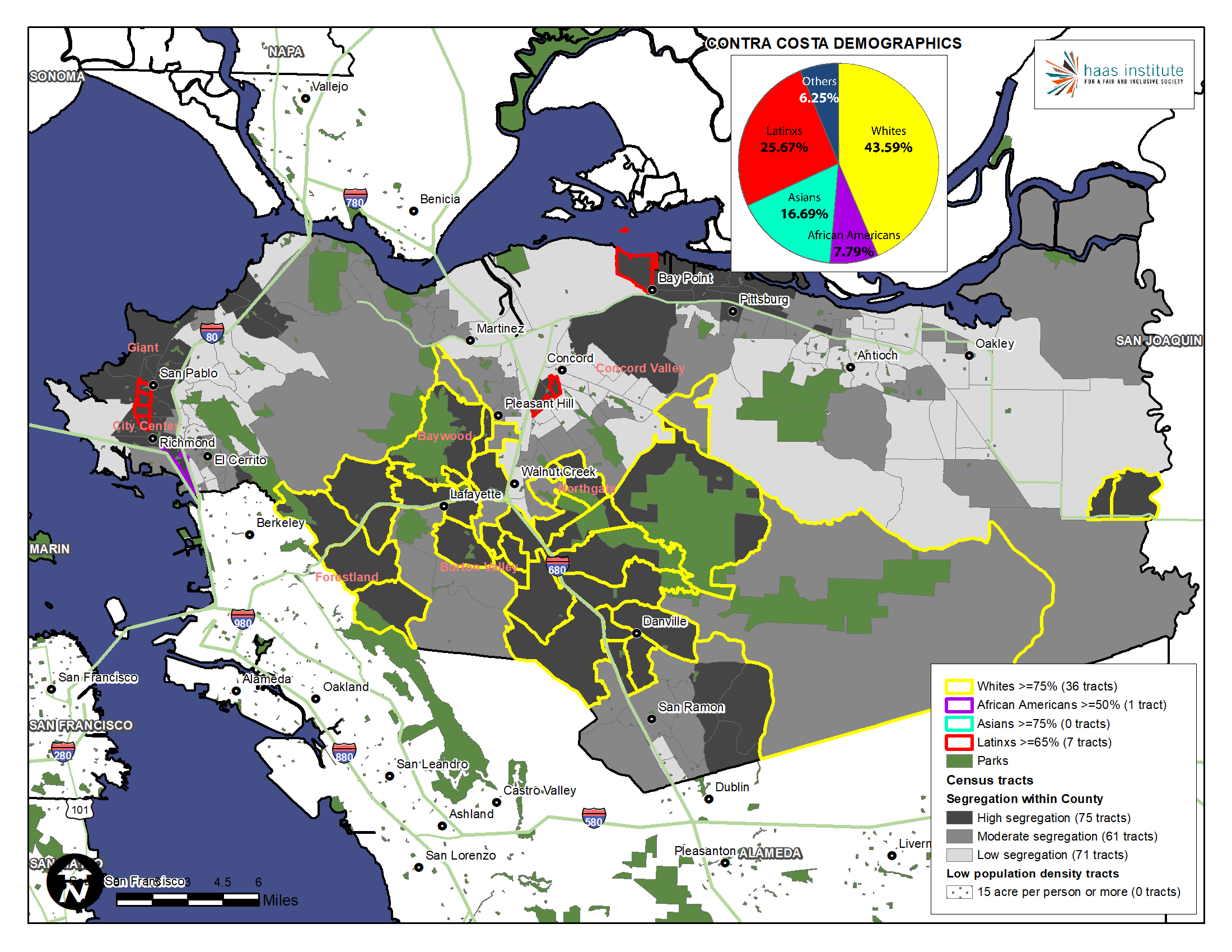
Contra Costa County is dwelling house to nearly 2 dozen cities of varying size and demographics.23 Similar Alameda County, information technology is a canton of stark racial segregation. Only 20 per centum of its tracts have a similar proportion of white people to the county's population. For Latinos, Asian, and Black people, those percentages are xvi percent, 20 pct, and 9 per centum, respectively.
The most segregated and heavily white cities in the county are Walnut Creek, Lafayette, and Martinez, which epitomize the affluent white suburb. In fact, two of the most racially segregated white neighborhoods in the entire Bay Area are located in Walnut Creek, which is 63 percent white. Martinez is 69 pct white, and Lafayette is a scale topping 77 percent white, a remarkable instance of white exclusivity.
Forth with these iii cities, the communities of Clayton, Danville, Moraga, Pleasant Hill, and Orinda are also segregated, heavily-white cities. These cities are 63-78 percent white, one-3 percent Black, vi-11 percent Latino, and vii-20 percent Asian. These are followed by the less intensely segregated, but still heavily white cities such as Concord and Brentwood, which are 52-53 pct white, 3-vi percent Black, eight-14 percent Asian, and 26-27 percentage Latino.
At the extreme western side of the county is the city of Richmond and the unincorporated area of North Richmond. Richmond is home to the Chevron refinery, only was likewise a hub for factory workers during World War II, and recruited thousands of African Americans to its shipyards. Richmond'south neighborhoods are highly segregated by race, especially for Latinos and African Americans. Although the Black population has declined in numbers substantially in recent years, partly as a effect of displacement and gentrification, Richmond is currently eighteen percent African American, 17 percent white, 13 percent Asian, and 48 percent Latino.
Richmond, like Pittsburg and San Pablo, are segregated communities that are heavily Latino, much like Hayward in Alameda Canton. San Ramon and Hercules are the most segregated, merely predominantly Asian communities in Contra Costa Canton, and the analogs to Fremont and Matrimony City in Alameda Canton
Pinole is the nearly integrated urban center in Contra Costa Canton, with a population that is 35 percent white, 26 per centum Latino, 22 percentage Asian, and 8 per centum Black. Antioch, the 2d largest city in the canton, is the next almost integrated, although more than heavily Blackness and Latino, with a population that is 26 percent white, 34 percentage Latino, 19 percentage Black, and 13 per centum Asian. These communities are the well-nigh mirror opposites of cities in the eastern and central reaches of the county.
Santa Clara County
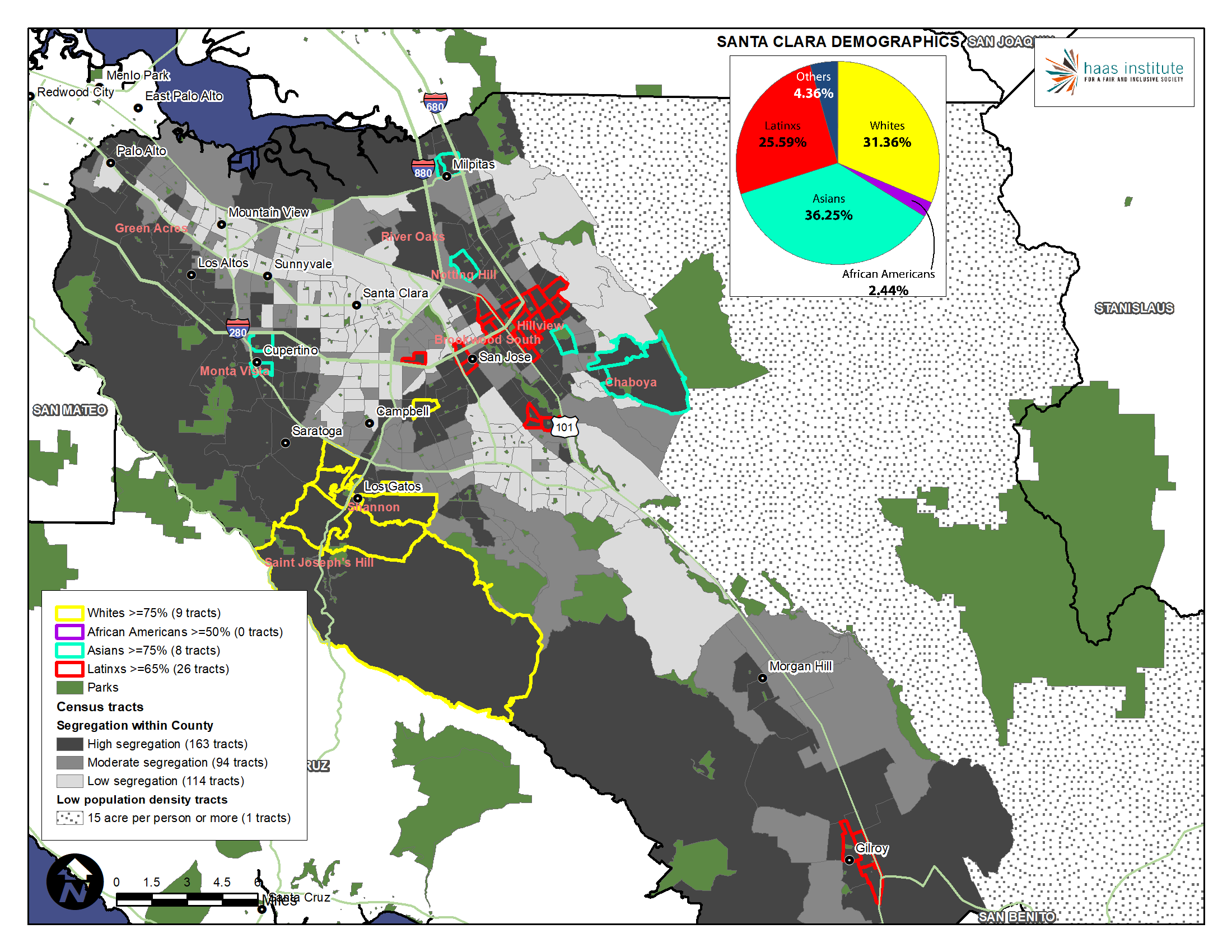
Habitation to Silicon Valley, Santa Clara Canton is one of the most economically prosperous counties in the Usa. It is also home to many traditional working-grade communities and neighborhoods and even contains rural communities such every bit Gilroy. Given the diversity of people residing in Santa Clara Canton, its neighborhoods and communities remain remarkably segregated. In fact, two of ten the nigh segregated Latino neighborhoods in the entire Bay Area are in Gilroy.
In general, all the same, each racial grouping is nearly as segregated from one another within Santa Clara Canton. Just 19 percent of its tracts take a similar proportion of white people to the county's population. For Latinos, Asian, and Black people, those percentages are 19 per centum, 19 percent, and xx percent, respectively.
San Jose is one of the largest and most diverse cities in the Bay Area. Its population is 26 percent white, 32 pct Latino, 35 percent Asian, and 3 percent Black. Nevertheless, like Oakland, its neighborhoods do not reflect the diverseness found across the metropolitan region, let lone within the urban center limits. Ii of the census tracts in due north San Jose are among the 5 most segregated for Asians in the entire Bay Surface area. Latinos are also incredibly segregated into the neighborhoods of San Jose. Six of the 10 near segregated neighborhoods in the entire Bay Surface area for Latinos are found in Santa Clara County, in places like Gilroy and the surroundings of San Jose.
Monte Sereno city, Los Gatos, Los Altos, Los Altos Hills, Campbell, and Palo Alto are the almost segregated, heavily white cities in the county, with populations that range from 55-78 per centum white, 0-ii percent black, two-xviii percent Latino, and fourteen-33 pct Asian. They are followed by predominantly white, but more Asian cities like Morgan Hill and Saratoga.
Gilroy is a highly segregated and threescore percent Latino customs in the southeastern part of the county, while Milpitas and Cupertino are mirror opposites for Asians, but with 62 and 66 pct Asian populations, respectively.
There is no truly integrated city in Santa Clara County like Pinole or Newark in Contra Costa and Alameda counties, but the most diverse and integrated cities are Mountain View, Santa Clara, and Sunnyvale.
San Francisco County
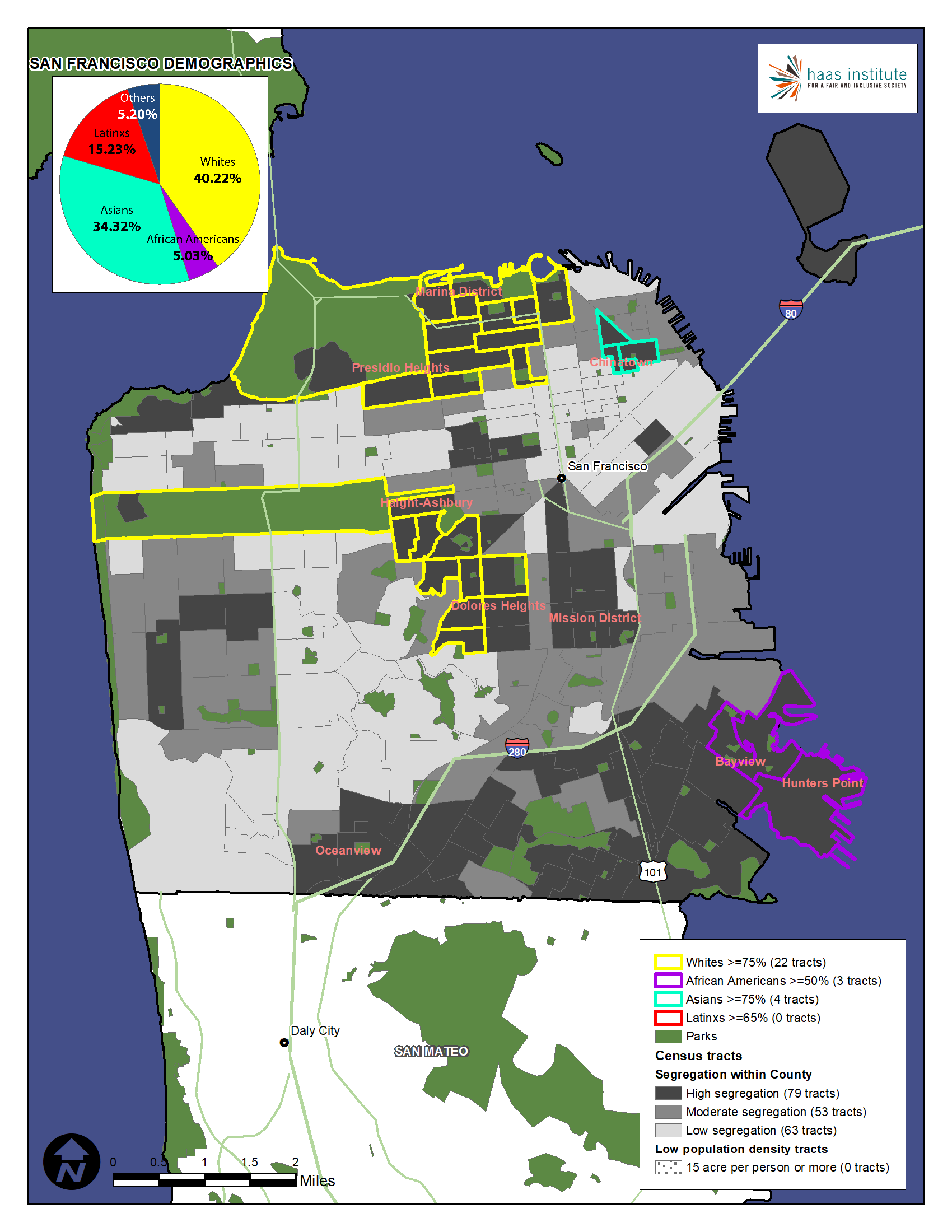
San Francisco Canton has almost the verbal same boundaries as with the city of San Francisco. For that reason, the city and canton can exist described interchangeably. A richly diverse place, in that location is a surprising caste of racial segregation which belies its inclusive reputation. Few census tracts reflect the demographics of the canton for whatsoever racial group. Just 29 percent of its tracts have a like proportion of white people to the canton'due south population.24 For Latinos, Asian, and Black people, those percentages are fourteen percent, 23 percent, and 9 per centum, respectively.
Although African Americans are just 5 percent of the population (every bit of 2017), they are intensely clustered into the Hunter'south Point/Bayview neighborhoods and some parts of the downtown area. This is a issue of the extremely high cost of housing and rents in San Francisco, but information technology is also a effect of historical patterns of segregation which prevented blacks from moving into other neighborhoods.
A similar story could exist told about Asians during the nineteenth and early on twentieth centuries regarding San Francisco's famous Chinatown which advisedly restricted where Asians could live. The Mission, once an overwhelmingly Latino neighborhood, has been radically gentrified in recent years with many of its original and long-term residents pushed out by rising costs. Whites are disproportionately concentrated in the northern and cardinal parts of San Francisco, especially the Presidio.
San Mateo County
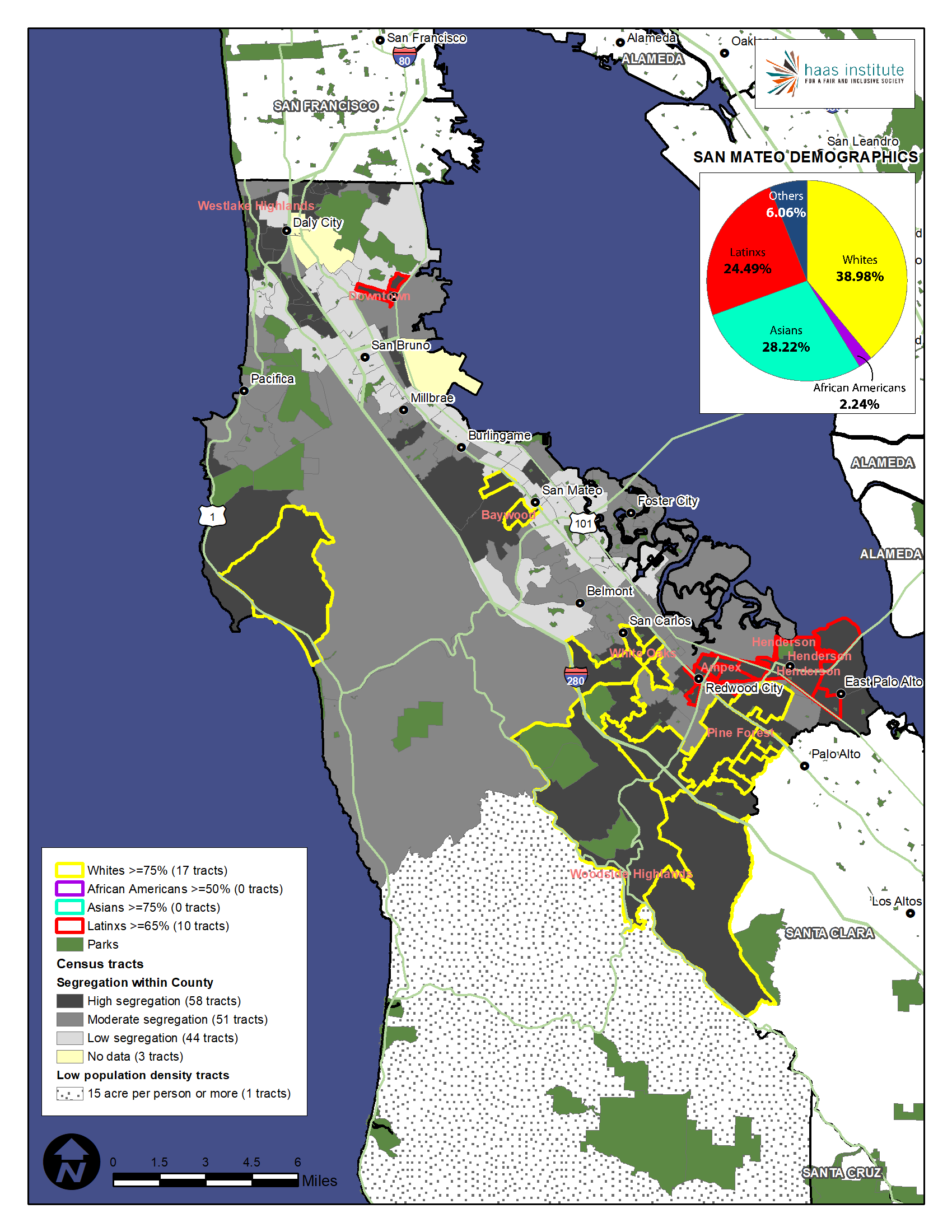
San Mateo County extends s of San Francisco to comprehend the San Francisco drome and suburbs and the northern role of Silicon Valley. Information technology is therefore one of the most affluent places in America and home to a number of corporate campuses for Fortune 500 and 100 companies. It is also a highly segregated county. Few census tracts reverberate the demographics of the county for whatever racial grouping. But 24 per centum of its tracts have a like proportion of white people to the canton'due south population. For Latinos, Asian, and Black people, those percentages are 21 percent, 15 percent, and 15 pct, respectively.
Research shows that regions with higher levels of municipal fragmentation tend to be more than segregated.25 Like Contra Costa and Santa Clara counties, San Mateo County is municipally fragmented with nearly ii dozen relatively small incorporated jurisdictions, and many smaller unincorporated ones. Information technology differs from those counties however, in that it lacks an urban core.
The small simply extremely wealthy urban center of Atherton, which is 75 percent white, fourteen percent Asian, 5 percent Latino, and less than 1 per centum black, epitomizes the segregated, exclusive customs. This segregation is the corollary of the segregation of places similar Eastward Palo Alto. East Palo Alto is also a historically significant site of racial segregation, and remains so today, but for Latinos rather than African Americans. Additionally, Redwood City has roughly 40 percentage of whites and Latinos, which seems more diverse but racial groups are segregated in their own enclaves.
Millbrae and Daly City are moderately segregated, and have a predominantly Asian population.
San Bruno is the nearly diverse and racially integrated urban center in the county, with a population that is 35 percent white, two per centum black, 28 percent Asian, and 28 percentage Latino. Although San Mateo City likewise has a disproportionately modest Black population, it is also one of the more integrated cities in the county.
Marin Canton
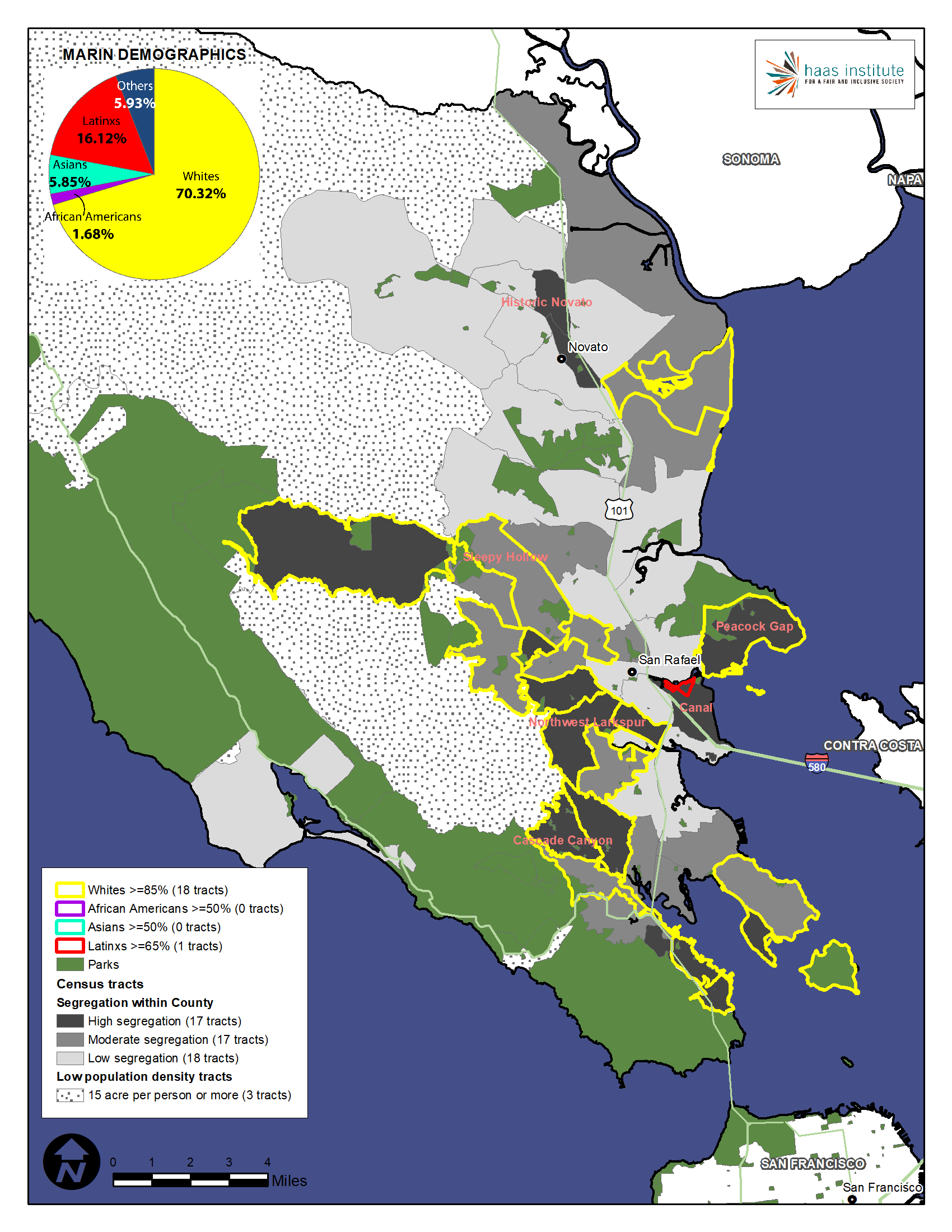
Marin County is one of the most scenic counties in the Bay Area, featuring miles of shoreline, parks, and other pastoral views. Despite its reputation equally a breastwork of progressivism and environmentalism, it is one of the near segregated counties in the Bay Area, particularly for whites. In fact, it might exist off-white to say that the entire canton is segregated. The large number of whites may mask this. Sixty percent of its tracts have a like proportion of white people to the county's population. On the other hand, for Latinos, Asian, and Black people, those percentages are 15 pct, 29 percentage, and 7 percent, respectively.
Although Sonoma is the 'whitest' county in the Bay Area, five of the 10 most segregated census tracts in the unabridged Bay Expanse for whites are located in Marin County as is visible above. A small-scale number of clustered public housing or affordable housing communities are home to many of the people of color in the canton. Anti-development policies strictly regulate where new or affordable housing tin can be congenital, helping maintain patterns of racial segregation. Equally nosotros will come across in the next brief in this series, yet, many people of color accept left or been displaced from Marin county in recent decades.
A neighborhood in San Rafael, as highlighted in the map, is the most segregated tract for Latinos in the entire Bay Expanse, where more than xc percent of population is of this group. Novato besides contains a substantial number of Latinos, with a nineteen percent Latino population.
Sonoma Canton
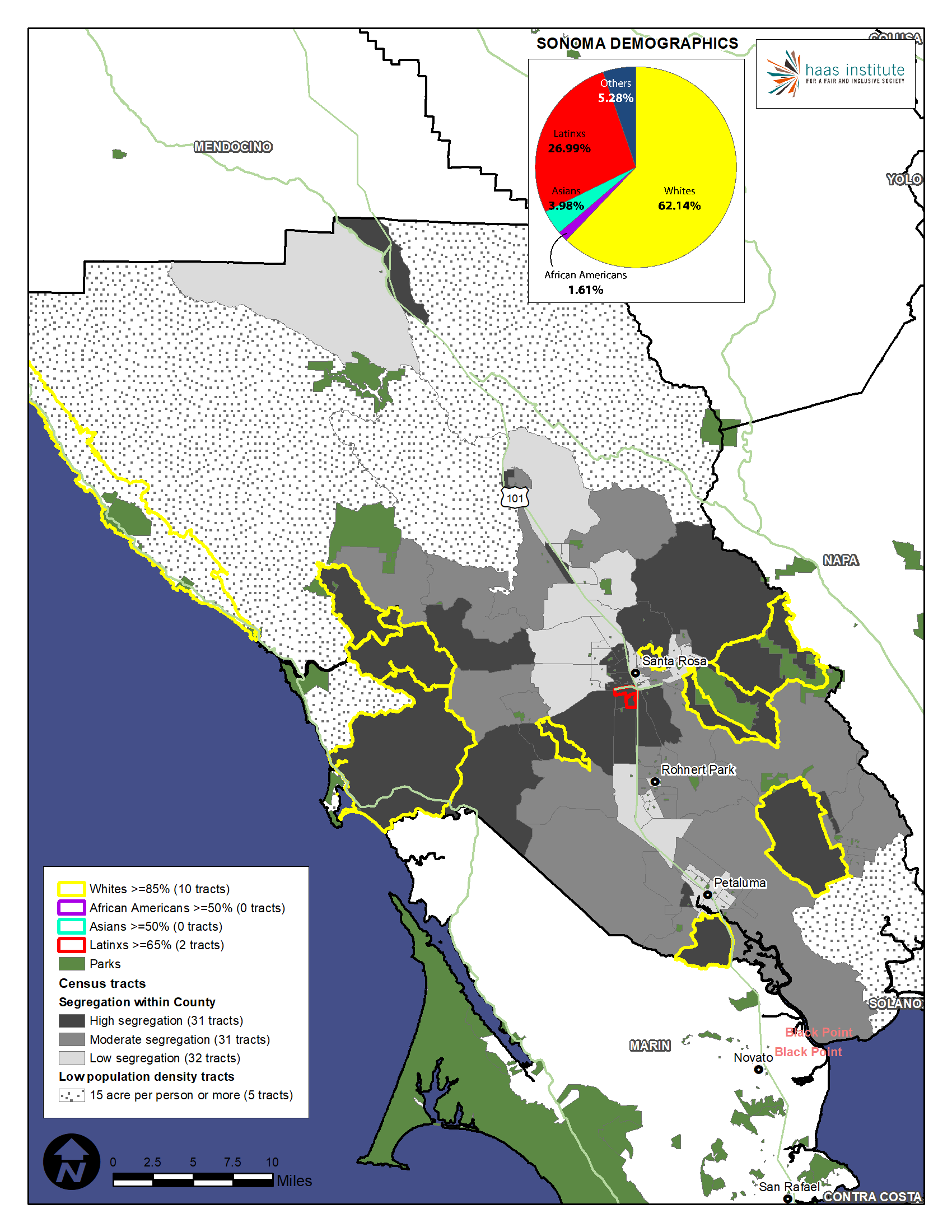
A viticultural and agricultural hub, and the largest vino producer in California, Sonoma Canton is some other breathtaking office of the Bay Surface area. Despite its rural character, Sonoma'southward multifariousness - which is greater than Marin'southward -- is not reflected in its neighborhoods. Fifty-i per centum of its tracts have a similar proportion of white people to the canton's population. For Latinos, Asian, and Blackness people, those percentages are 23 percent, 26 percent, and 13 percent, respectively.
In many respects, Sonoma is a analogue to Marin in that information technology is a place where white families are exceptionally segregated from people of color. Three of the six whitest segregated neighborhoods in the Bay Area are establish in Sonoma, neighborhoods in or around Santa Rosa.
Although Sonoma is 62 percent white, just two of the 9 incorporated cities in Sonoma have more an fourscore per centum white population: Sebastopol and Sonoma City, and are therefore the most segregated cities for whites. On the flip side, just 2 cities take less than a 60 percent white population, Santa Rosa and Cloverdale.
The largest minority group in Sonoma are Latinos, which are overrepresented and amassed in Cloverdale, Healdsburg, Santa Rosa, and Windsor town.
Petaluma and Rohnert Park are the most integrated cities in the county.
Napa County
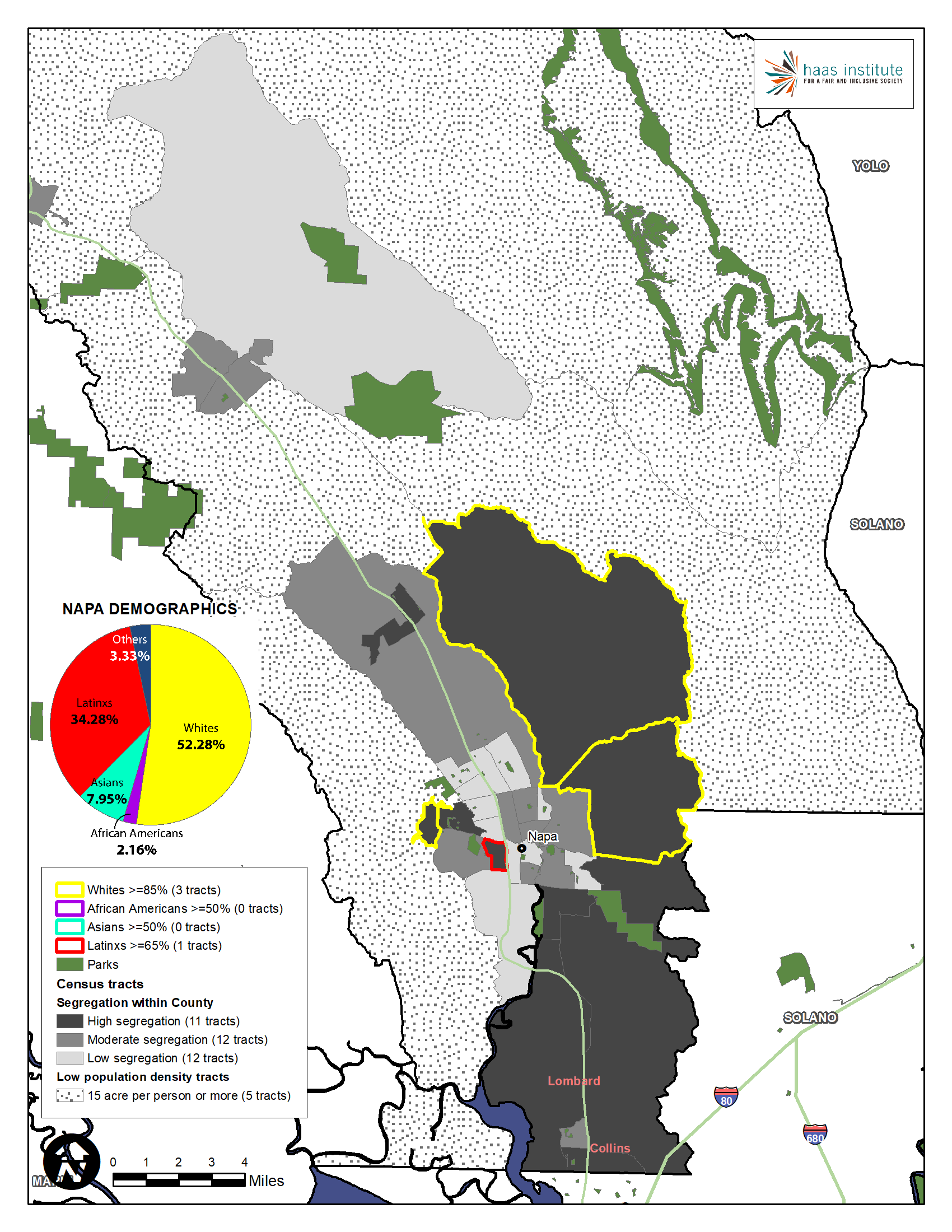
With 400 wineries, Napa County is nigh famous as a wine growing region along with its neighbor, Sonoma County. Both counties accept similar demographics featuring a majority white population. Despite the large white population, just 40 percent of its tracts take a similar proportion of white people to the canton'south population. For Latinos, Asian, and Black people, those percentages are 23 percentage, 10 percent, and v pct, respectively.
In that location are communities in Napa County that are predominantly not-white. American Canyon urban center is predominantly Asian, whereas Calistoga is predominantly Latino.
Yountville is the almost segregated, heavily white city in Napa County. St. Helena is moderately segregated, past comparison.
Notably, Napa city is the nigh integrated city in the county with a population that is 55 percent white, 39 percent Latino, three percent Asian, and less than one percentage black.
Solano County
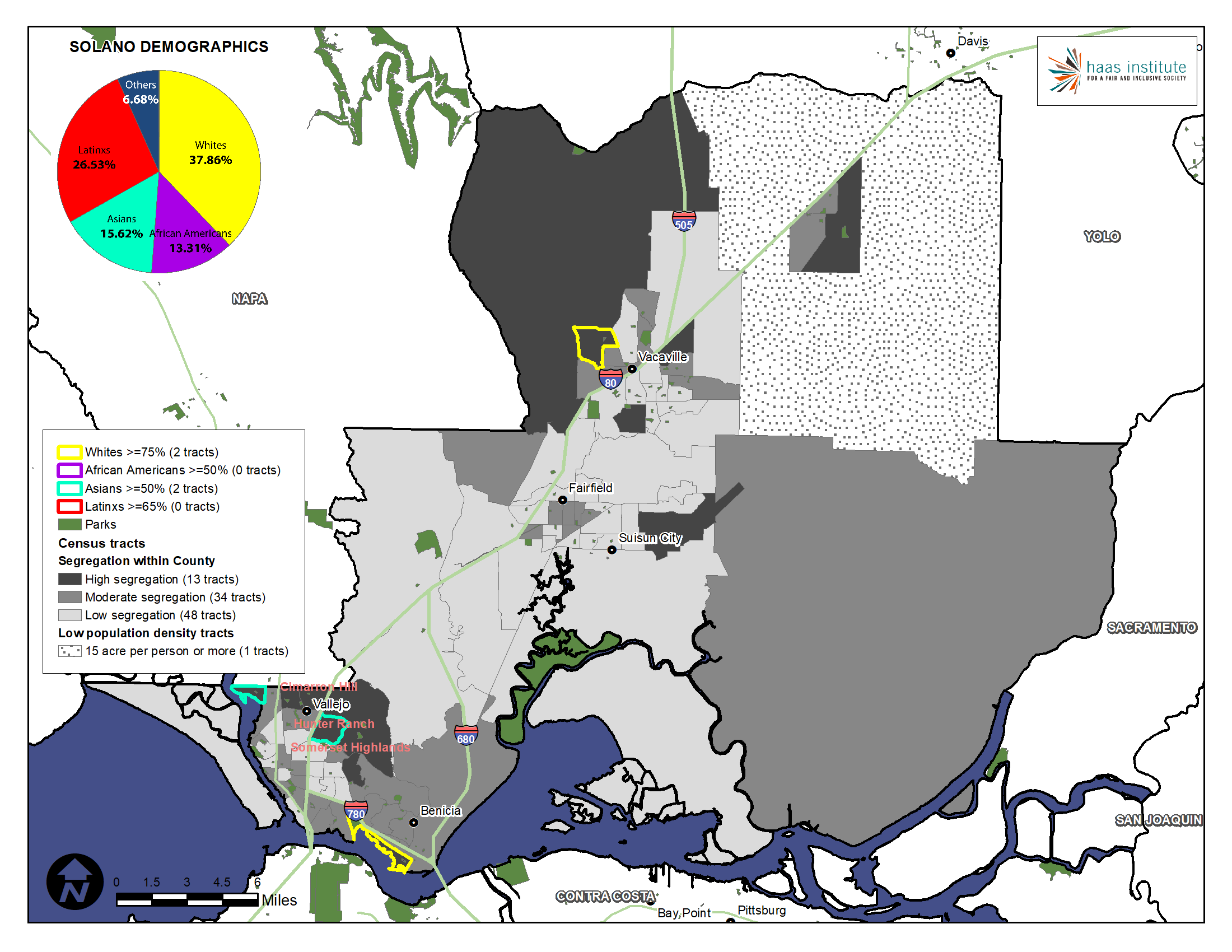
Ane of the oldest counties in the state, Solano Canton is much more diverse than its neighbor, Napa. It may too be the most integrated canton in the Bay Expanse. Although still a depression number, a college than boilerplate number of census tracts have a like proportion to the racial limerick of the canton as a whole. Twenty-seven percent of its tracts have a similar proportion of white people to the canton's population. For Latinos, Asian, and Blackness people, those percentages are 31 percent, 17 percent, and 23 pct, respectively, the highest numbers nosotros've seen for Latinos and Blacks. This also suggests the unusual fact that Asians may be the most racially full-bodied group in the canton.
Solano has the everyman percentage of highly segregated census tracts of any canton in the Bay Area. Exemplifying this pattern, both Suisun Metropolis is highly diverse and integrated, with about perfectly even breakdowns of each racial grouping. Fairfield and Vacaville are a mixture of integrated and only moderately segregated.
Solano also has a sizable and historic black community. Cities like Vallejo, even so, are various, only non as well integrated. Its population is 24 percent white, 19 percent black, 23 percent Asian, and 28 percent Latino, illustrating another textbook example of how an unquestionably various community can yet exist segregated.
Rio Vista and Benicia are the two near segregated, and heavily white cities of Solano Canton.
Segregation in the Metropolitan Areas
Several major metropolitan regions cut across counties in the Bay Area. Therefore, another useful perspective on racial segregation is to see the segregation that exists within the region'due south major metropolitan regions. The San Jose MSA is the about integrated metropolitan region, and is substantially more integrated than the Oakland of SF MSA.
San Francisco–Oakland–Hayward MSA
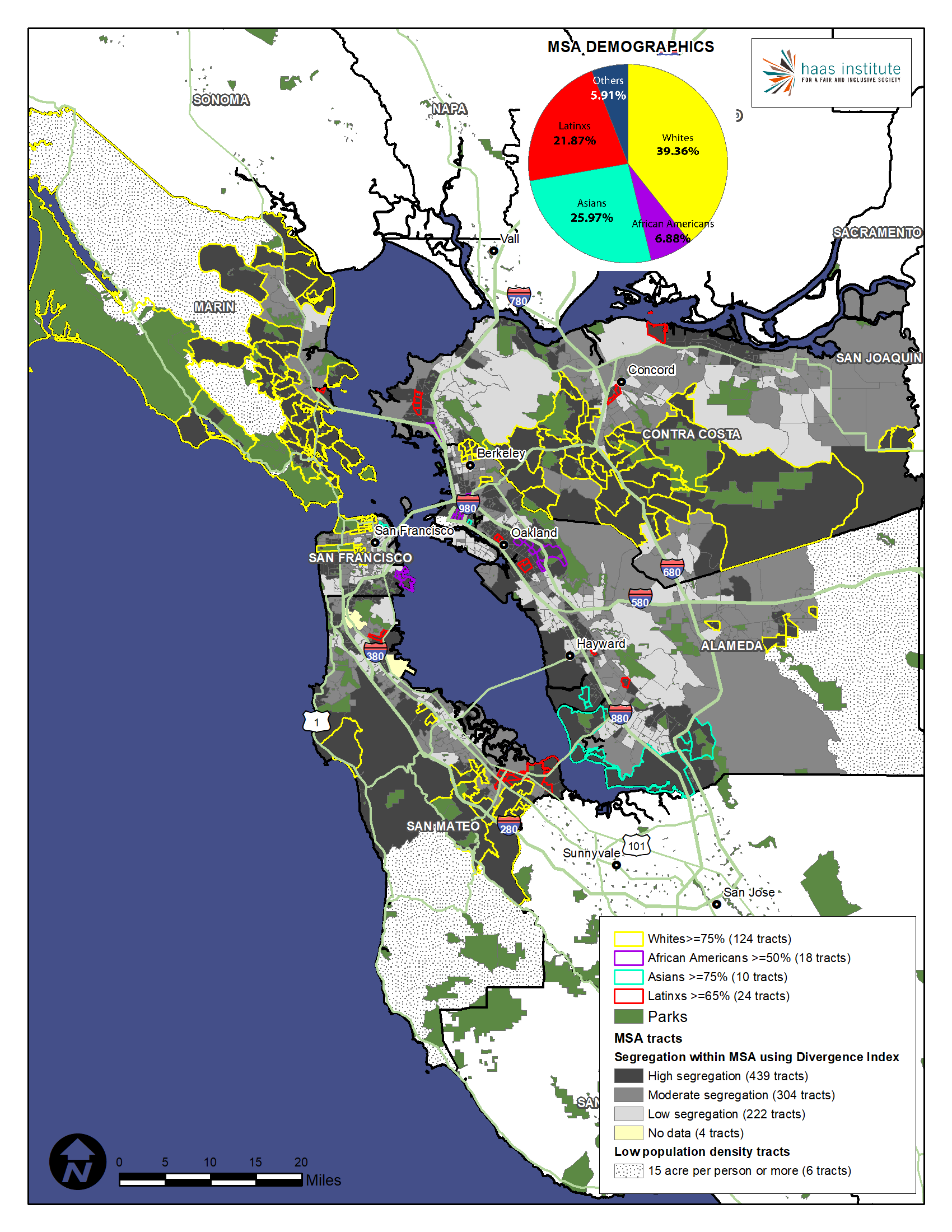
Demographics of this MSA are marginally different from the Bay area as a region. However, segregation is as pronounced in this four county MSA equally it was in the Bay expanse. Considering that whites are the most segregated racial group in the region, there are 124 tracts in this MSA that take non-Hispanic whites more than 75 percent. As discussed before, Marin County is predominantly white, then it is no surprise that the top ten tracts with high segregation due to not-Hispanic whites are in Marin County. The 18 tracts that accept 50 per centum or more of African Americans are the same as those in the Bay area. Thus segregated areas for blacks are mainly concentrated in this MSA region. Six out of x of these highly segregated tracts are in Alameda County, three in San Francisco and one in Contra Costa County.
As shown on the map, at that place are 8 tracts that have 75 percent or more of Latinos. Four of these are in Contra Costa County, out of which three are in the city of Richmond. Three of those eight tracts are in the urban center of Redwood City in San Mateo County. The remaining one tract is in Marin County in the urban center of San Rafael. Mentioned earlier, 90 pct of this tract's residents are Latino.
Six out of the top ten segregated tracts with 75 percent or more of Asians are in Alameda County, five primarily in Fremont and Union cities, and 1 in the metropolis of Oakland. Three are in San Francisco.
San Jose–Sunnyvale–Santa Clara MSA
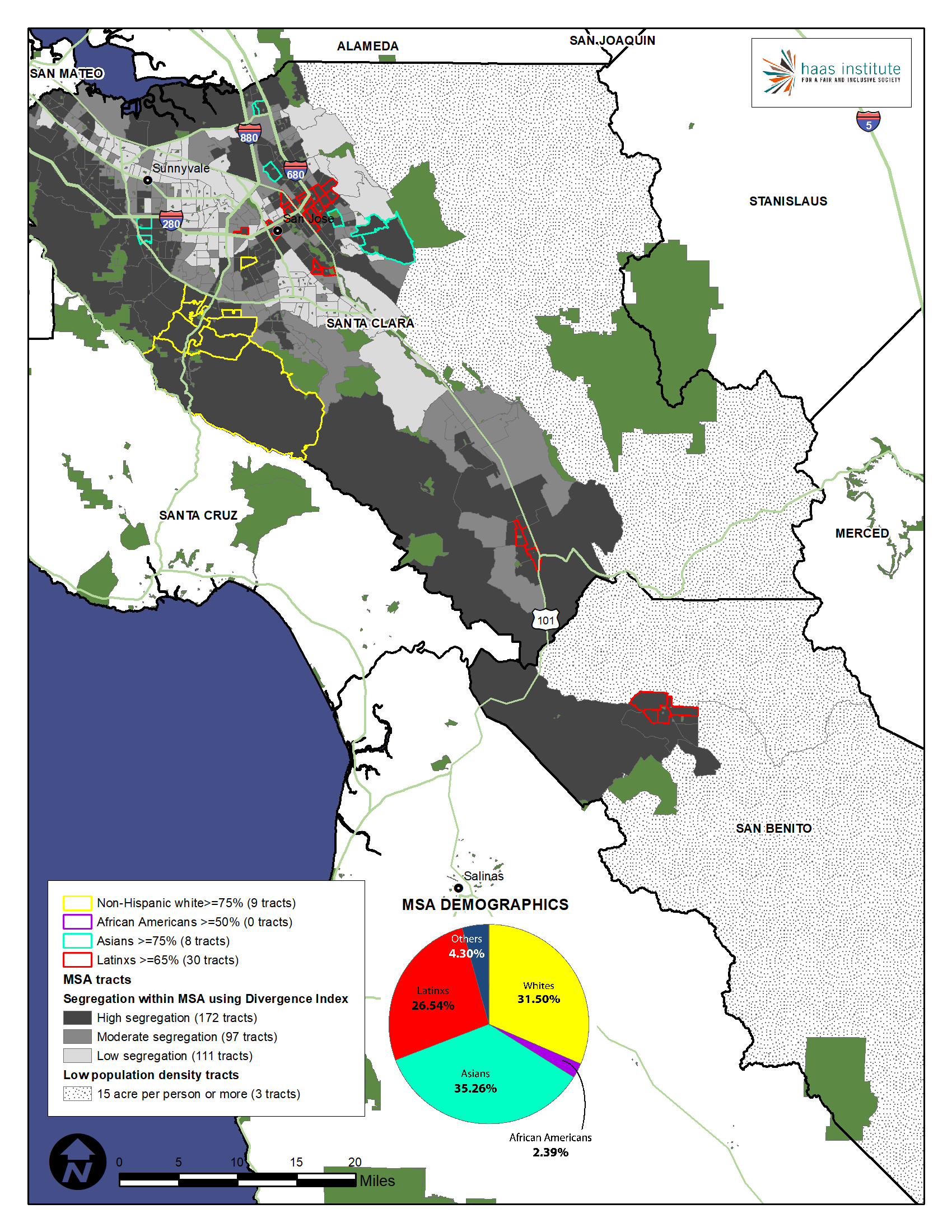
This MSA seems to be the most diverse based on the demographic data equally shown above. However, the map above illustrates how segregated are some of its neighborhoods are with clearly demarcated areas of racial concentration. Eight of 9 tracts with white population 75 percent or above are in the boondocks of Los Gatos and beyond, while one is in the city of San Jose. According to our metric, there doesn't seem to be any segregated neighborhoods with African Americans in this MSA.
On the other hand, 4 out of 8 tracts with 75 percentage or more of Asians are in San Jose. Of the remaining 4, 2 are in Milpitas and 2 in Cupertino. Loftier tech industry in Silicon Valley is the master source of employment of It professionals from Asian countries such as India and Communist china, and thus it is non surprising to find neighborhoods with such high concentration of Asians.
Latinos have the highest number of segregated neighborhoods in this MSA. Ten out of fifteen such neighborhoods are in San Jose, 2 in Gilroy, and the remaining three in and around the urban center of Hollister in San Benito County.
Decision
Whether seen from the regional perspective, the county level or the metropolitan level, the San Francisco Bay Area is simultaneously diverse just too notably and starkly segregated. The diversity of the region masks considerable levels of racial isolation and historical, persistent segregation. The measure of segregation nosotros have employed here, the Departure Alphabetize, helps united states of america identify areas that are segregated despite a loftier caste of overall diversity. It also helps us run across which communities are especially segregated every bit a mode of kickoff to empathise the trouble we must confront and accost.
More than half a century later the enactment national Fair Housing Act and nearly six decades since California's Fair Employment and Housing Act, the state remains racially segregated, with the Bay Area as a vivid instance study. These segregated residential patterns shape the life chances of its residents, who non merely reside in racially segregated neighborhoods, simply nourish racially segregated schools and accept racially differentiated access to a plethora of public and individual resource as well. Racial segregation, every bit nosotros will testify in more than detail in part three, shapes life chances and is the master instrument of racial inequality.
Our next brief in this serial will examine current and historical patterns of racial demographics which underlay these segregation maps. These maps will advise how these communities became segregated past showing how racial alter occurred in the Bay Area.
We anticipate that our briefs will generate a range of responses, including questions about how nosotros define or anticipate racial segregation. These briefs are presented in sequence so that we might likewise collect feedback and incorporate suggestions before compiling the briefs into a final report, so please send us your questions or ideas to HousingOBI@berkeley.edu.
aquinochaketherver.blogspot.com
Source: https://belonging.berkeley.edu/racial-segregation-san-francisco-bay-area-part-1
0 Response to "Alameda City History of Discriminating Agains Minorities"
Post a Comment